


The 2025 IESNYC Thesis Awards Celebrate Outstanding Academic Work
The New York City Section of the Illuminating Engineering Society (IESNYC) has announced the recipients of its 2025 Thesis Awards. These annual honors recognize outstanding graduate work that advances lighting design and research in meaningful ways.
A Firsthand Look at the Future of Lighting
Earlier this year, I had the chance to attend the thesis presentations at the New School at Parsons in person for the first time. The quality of the work blew me away. The ideas were thoughtful, the innovation was clear, and the technical depth was impressive.
The next generation of lighting professionals is ready to lead—with both purpose and creativity. Their work demonstrates a profound understanding of how lighting affects space, safety, and overall experience.
Celebrating Three Emerging Leaders
This year’s winners—Hyesoo Chun, Veronica Gonzalez, and Kai-Di Peng—each received a $2,500 award and well-deserved recognition from the IESNYC community.
Hyesoo Chun
Parsons School of Design – MFA in Lighting Design
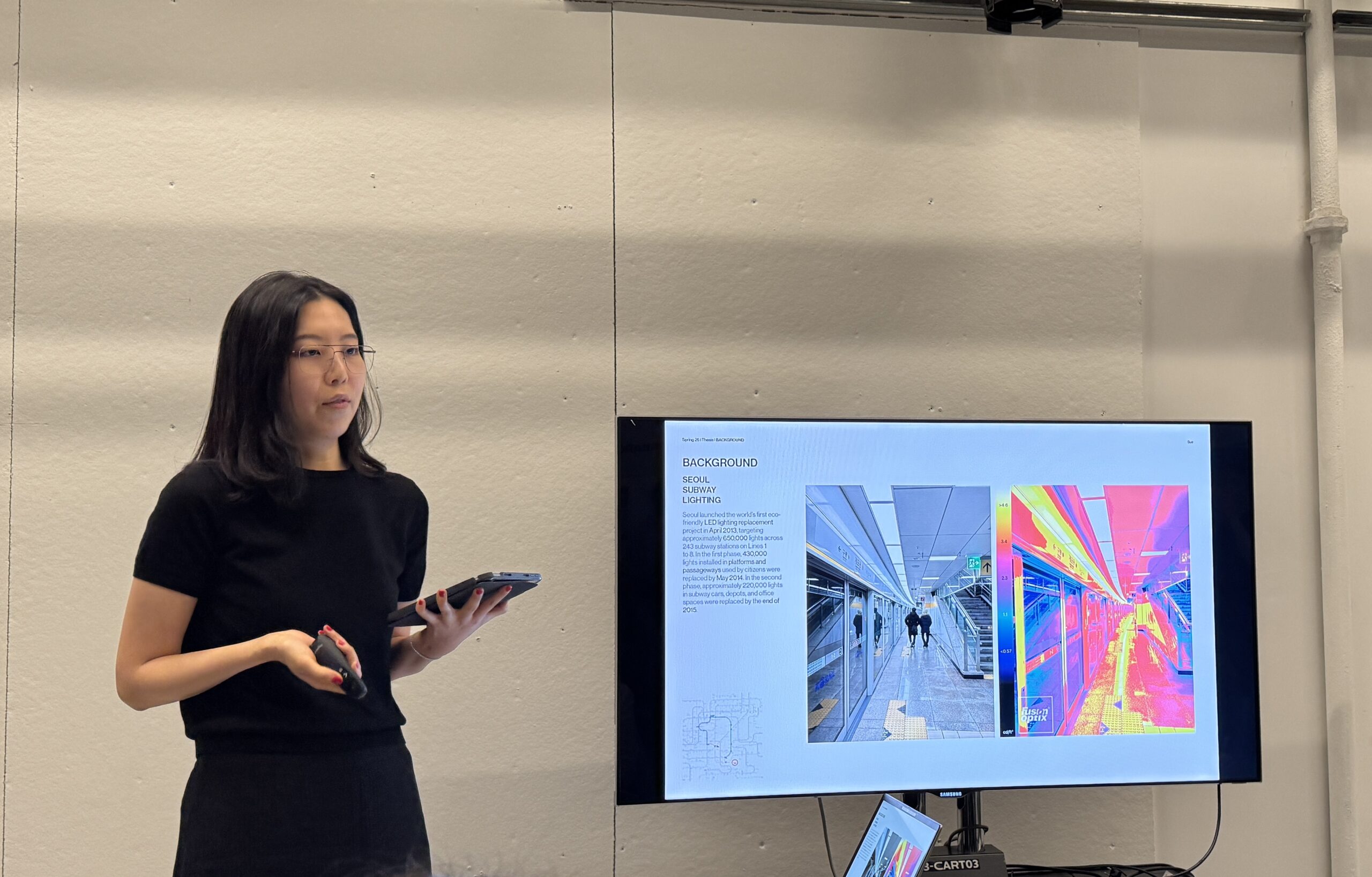
Thesis: “More Isn’t Always Enough: Challenging the Perception of Safety on NYC Subway Platforms”
Chun’s research questions the assumption that brighter lighting always leads to safer environments. Her work explores how glare control, balanced luminance, and spatial contrast can enhance the sense of safety on subway platforms without overexposure.
Veronica Gonzalez
New York School of Interior Design – MPS in Lighting Design
Thesis: “Playful Layers: Children’s Home”
Gonzalez developed a residential lighting approach tailored specifically for children. She focuses on scale, color, and interactivity—creating layered lighting systems that are both functional and playful, supporting daily life and imagination.
Kai-Di Peng
Rensselaer Polytechnic Institute – MS in Architectural Sciences (Lighting)
Thesis: “Development of a 3D-Printed Optic for an LED Accent Light Used in Museum Applications”
Peng designed a custom 3D-printed lens that improves lighting efficiency in museums. Her system directs light precisely, minimizing waste and protecting sensitive artwork from overexposure.
These projects represent the kind of boundary-pushing thinking that will shape the future of lighting.
Read my original article here
Read the IESNYC article here.