

From Concept to Skyline: Crafting the World’s Tallest Lighting Experience
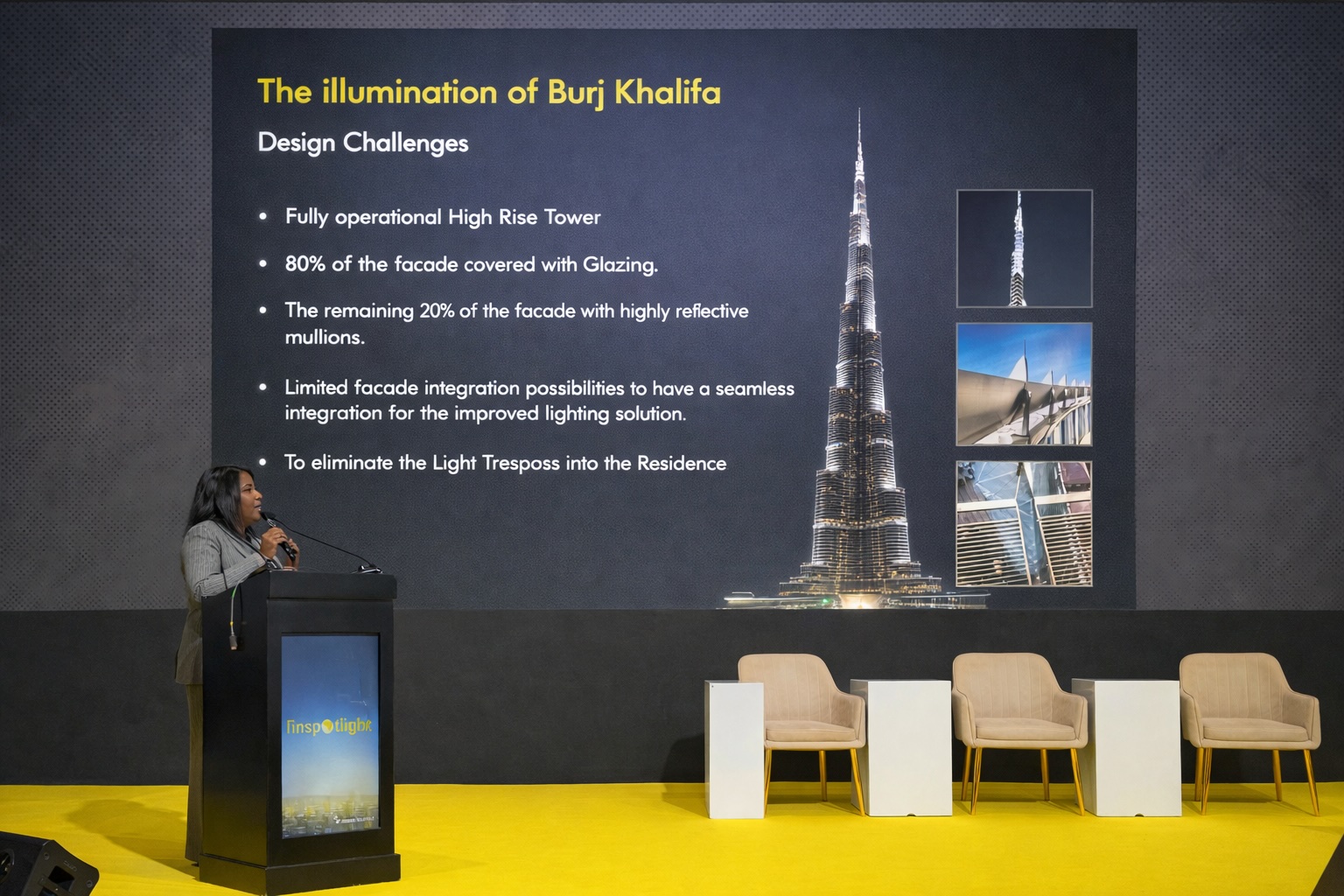
At Light + Intelligent Building Middle East, I had the pleasure of introducing a presentation that felt less like a technical case study and more like a rare look behind the curtain of one of the most complex lighting projects ever undertaken. The subject was the lighting facade evolution of the Burj Khalifa, the tallest building in the world, and the speakers were Waleed Fakousa, Principal, and Ratna Kumari, Senior Associate, of CD+M Lighting Design. What followed was a candid, deeply technical, and refreshingly honest account of what it takes to re-light a global icon at nearly a kilometer in height.
This article is based on that presentation, From Concept to Skyline: Crafting the World’s Tallest Lighting Experience, delivered at Light + Intelligent Building Middle East, and draws directly from the project narrative shared on stage.
A Client Brief That Changed the Rules
CD+M’s relationship with the Burj Khalifa did not begin with architectural lighting. In 2016, the firm designed what was then the largest media façade in the world. That system still operates today. But in 2022, the client returned with a different challenge. The tower was already visible. Already iconic. What they wanted now was presence—greater visibility across the city, richer color dynamics, and a lighting identity that could stand apart even amid Dubai’s increasingly luminous skyline.
The mandate was clear: enhance the existing architectural lighting without compromising operations in one of the most complex mixed-use buildings on the planet.

Photo by Max Bovkun
Understanding a Kilometer-Tall Canvas
Ratna Kumari led the audience through the earliest phase of the work: understanding the building itself. The Burj Khalifa is not a uniform façade. It is a spiraling composition of tiers, setbacks, and reflective surfaces, viewed from radically different angles—fountain-side, Sheikh Zayed Road, residential districts, and even from the sea.
Lighting visibility had to be evaluated not only from close proximity, but from one kilometer, five kilometers, and beyond. Complicating matters, nearly 80 percent of the façade is glazed, with highly reflective stainless-steel elements that behave very differently at distance than they do up close.
The existing system relied heavily on wall-mounted luminaires and railing-mounted fixtures, many originally designed around metal halide sources and later converted to LED lamps. While functional, the system was static, limited in aiming flexibility, and uneven in long-range impact.
The Reality Check No Software Can Predict
One of the most revealing moments of the presentation came during the discussion of mockups. On paper—and even on site—the new high-output RGBW luminaires looked extraordinary. Standing on the tiers, the tower glowed. The sky lit up. Everything suggested success.
Then the team crossed Sheikh Zayed Road.
From that distance, much of the lighting effect simply disappeared. The reason was not lumen output alone, but geometry and reflectivity. The louvers and fins that appeared bright up close offered little retinal reflection at long viewing distances. This was not a calculation error. It was a perceptual reality that only revealed itself through full-scale testing.
For Waleed, this was a reminder that projects of this scale cannot be solved behind a screen. Atmospheric conditions, ambient city brightness, and human perception all matter as much as photometric data.
Designing a Luminaire That Didn’t Exist
The solution required more than selecting a different product. It required inventing one.
CD+M needed a luminaire with output, beam control, color mixing, and peak candela far beyond what the market offered—yet small enough to fit within existing railing housings only 135 millimeters wide. The initial optical packages were nearly twice that size.
Working closely with manufacturers, the team re-engineered housings, optics, thermal management, and LED chip configurations. Even the blue channel had to be rethought. As Kumari noted, the blue simply was not powerful enough to hold its own in long-distance color mixing, forcing a return to R&D.
The final solution delivered roughly 11,000 to 12,000 lumens per fixture with precise elliptical optics, packaged into a custom housing that maintained thermal stability, weight limits, and serviceability.

Photo by Timo Volz
Aiming at Night, Installing by Day
Execution brought its own set of constraints. The Burj Khalifa is a fully operational building, with residential units, hotels, and observation decks extending past level 150. Access permits were limited. Installation crews worked at heights exceeding 600 meters. Each balcony required approximately 48 luminaires to be aimed—and nighttime aiming windows were extremely short.
Most aiming had to be completed during daylight, with final nighttime adjustments executed under tight time pressure. Any misalignment risked light trespass into residences, something the team carefully avoided despite beam throws approaching 190 meters.
From Vision to Reality
What stood out most was the discipline behind the visuals. Fakousa made a point that resonated with many in the room: promising beautiful renders is easy. Delivering them at full scale is not. Every image CD+M shared early in the design process was grounded in test data, mockups, and hard-earned experience.
The result is a tower that reads differently now—stronger at distance, more articulate in color, and unmistakable across Dubai’s skyline. From the fountains to the World Islands, the Burj Khalifa once again asserts itself, not through spectacle alone, but through precision.
A New Baseline for Super-Tall Lighting
There is no way back from this point. The upgraded architectural lighting sets a new benchmark, not just for the Burj Khalifa, but for what is possible in super-tall building illumination. It is a reminder that at extreme scales, lighting design becomes a synthesis of engineering, perception, logistics, and restraint.
Introducing this talk was a highlight of Light + Intelligent Building Middle East for me. Listening to Waleed Fakousa and Ratna Kumari describe the project in their own words made one thing clear: this was not about making the world’s tallest building brighter. It was about making it legible, expressive, and unmistakably present—no matter how far away you stand.

This picture of the Burj Khalifa was taken by Charles Stone of Fisher Marantz Stone in January 2026
Charles Stone was at the show and noted that Fisher Marantz Stone was responsible for the lighting design of the Armani Hotel Dubai at the Burj Khalifa. The late Paul Marantz led the project and met in person several times with Giorgio Armani. In addition to the hotel, the firm designed the original tower lighting, all illumination for the surrounding plaza, roadways, and pedestrian areas, as well as the monumental lobbies of the residential tower.
Dinner at the Burj
My wife, Lori, and I recently had the pleasure of dinner at At.mosphere, the acclaimed restaurant atop Burj Khalifa that was a recent LIT Award winner. Designed by Nulty of London, the lighting plays a quiet but essential role in shaping the experience. Perched at the summit of the world’s tallest tower, At.mosphere is one of Dubai’s most celebrated fine dining destinations, and the lighting responds thoughtfully to both the refined interiors and the extraordinary views beyond the glass.

A breathtaking view at the at.mosphere restaurant at the Burj Khalifa
The scheme is composed rather than showy. Minimalist downlights, used sparingly across the ceiling, establish a soft ambient layer that never competes with the cityscape. In the reception area, a striking gold-embellished feature pendant introduces a moment of drama, adding warmth and elegance while setting the tone for what follows.
Editor’s Note: This article was updated on 20 JAN 2026 at 2:10 pm Eastern.