

At Parsons School of Design, lighting designers, educators, and technologists gathered to confront AI’s ethical frontier — before someone else defines it for them.
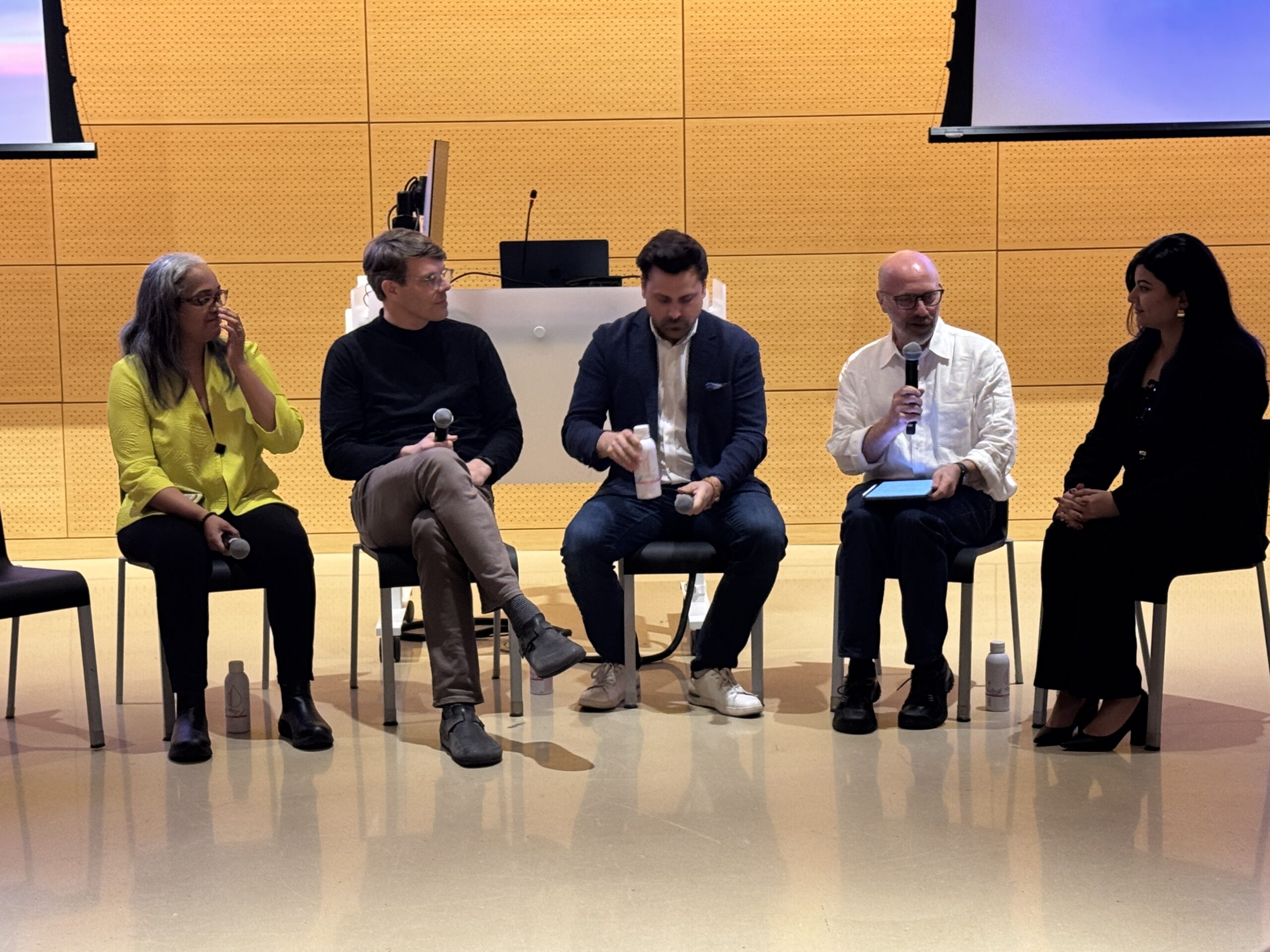
There was an unusual honesty in the room at Parsons School of Design’s Starr Foundation Hall last month. The people who had gathered — lighting designers, professors, technologists, and students — weren’t there to celebrate artificial intelligence. They weren’t there to condemn it either. They were there, as program host Glenn Shrum put it, to define what responsible AI use in lighting design practice looks like “before these terms are determined by others.”
That framing — urgent, collaborative, preemptive — set the tone for Projected Futures: AI Ethics in Lighting Design, a public program organized by Parsons School of Design that drew an engaged audience of students poised to carry these questions into the profession.
The Library That Writes Its Own Books
 Shrum, an Associate Professor of Lighting Design and Interdisciplinary Practice at Parsons, opened with a technology primer that grounded the conversation in a framework that was both accessible and precise. Conventional software, he explained, is a tool you pick up. Automation streamlines that tool. The internet made a vast library available to everyone. Early AI learned to catalog and personalize that library. But generative AI does something categorically different.
“It’s as if you now have a team of researchers who can summarize information — or even write entirely new books — based on your request. The library itself is expanding, and it becomes harder to distinguish what is factual from what is generated.”
It was a quiet bombshell of an analogy, and the room felt it land. Shrum was quick to note his own position in this shift: he used generative AI extensively to prepare the event itself — for research, organization, and even the program’s graphic identity. That transparency, he argued, is itself an ethical imperative.
“I believe this may be the most significant shift in lighting design practice I’ve seen in my career,” he said. “I don’t think that’s an exaggeration.”
Driver or Passenger?
De Angela Duff, Associate Vice Provost at New York University, brought a rigorous and personal lens to the question of authorship and agency. She described herself as firmly in the “augmentation” camp — someone who treats generative AI as a tool — but she was equally clear that the tool has unusual properties: it can blur the line between the user’s thinking and the system’s output in ways that other tools do not.
“Writing has traditionally been one of the clearest forms of thinking,” she told the audience. “It forces structure, reflection, and clarity. So what happens to thinking when the friction of writing disappears?”
Duff described what she calls a “sandwich model” for AI use: she begins with her own thinking, engages with AI in the middle stages, then returns to human review and refinement at the end. The point, she emphasized, is not to reject AI but to maintain genuine ownership of the intellectual process. She cited Cal Newport’s concept of “slow productivity” as a counterweight to the industry pressure toward speed — arguing that the friction of difficult thinking is not a bug to be automated away, but a feature of how expertise is built.
“Are you using AI to think better — or to avoid thinking? You must remain in control of your thinking.”
The questions she posed were simple on the surface and devastating in their implications: Are you the driver, or are you the passenger? Can you explain the output in your own words? Do you challenge what the system produces, or simply accept it?
The Field Without a Framework
Andrew Shea, Associate Professor at Parsons and co-director of the Lab for AI and Creative Labor, widened the lens to examine what AI is doing to creative labor across disciplines. The picture he painted was one of rapid, systemic disruption: AI-generated illustrations that replicate years-honed personal styles in seconds; music that mimics well-known artists convincingly enough that listeners can’t tell the difference; entire publication workflows replaced by multi-tool AI pipelines; virtual designers building full brand identities without human authorship.
The legal picture is unsettled but telling: a recent Supreme Court decision — by declining to take up an AI copyright case — effectively reinforced that human authorship remains a requirement for copyright protection. But Shea argued that the more pressing question is not legal but cultural.
“Medicine has bioethics. Journalism has editorial standards. What does design — and by extension, lighting design — have?”
He demonstrated his point with a visual exercise: two images, one a genuine Rembrandt, one AI-generated in the style of the master. The audience struggled to tell them apart. “The fact that we even have to ask — that’s the point,” Shea said.
The Algorithm That Specifies Your Lighting
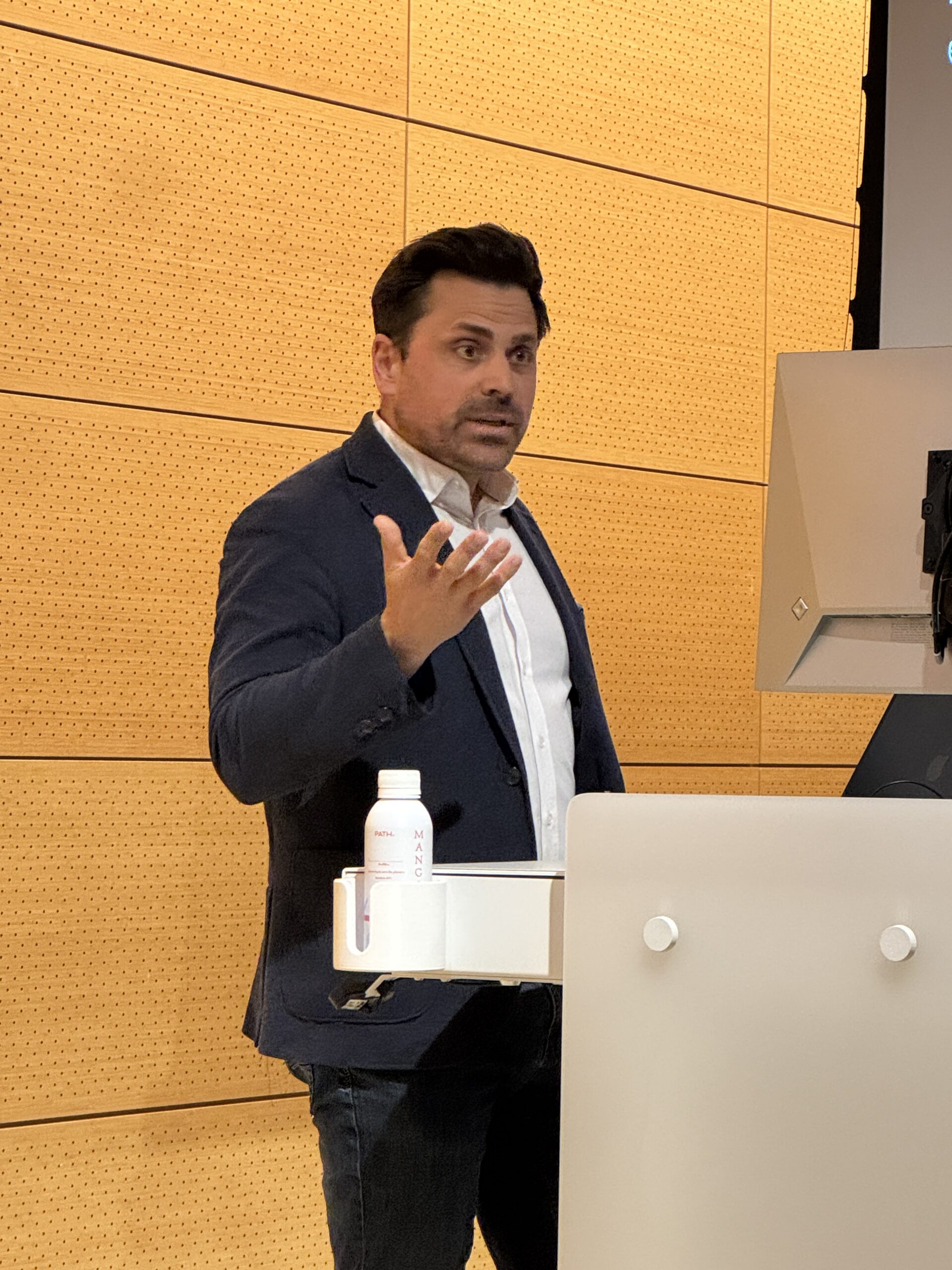 Paul Boken brought the most concrete and perhaps most immediately urgent perspective. As co-founder of Sourcery, a technology platform for lighting specifiers, he occupies an unusual vantage point: one foot in architectural lighting practice, one foot in the venture-backed tech world — two ecosystems he described as operating at very different speeds.
His core observation was that mainstream technology has now trained its attention on construction and design workflows — and the lighting industry is squarely in scope. “Not much has fundamentally changed in construction workflows since the 1990s,” he noted. “That’s exactly the kind of inefficiency that tech companies are now targeting.”
The specific scenario Boken described was AI-driven product specification: a system that curates and recommends lighting products the way a streaming algorithm curates music — instantaneously, personalized, and shaped by data and monetization logic that may be invisible to the designer. When product selection is driven by algorithms, he asked, who really controls the design outcome? Which products get recommended, and why? Who owns the underlying data?
“If recommendation engines begin to dominate, do we all start designing the same spaces? The nuance, the unexpected outcomes — that’s where design lives.”
He also raised a concern that rarely surfaces in these conversations: the risk to people. “This industry is built on people,” he said plainly. “I don’t want to see technology eliminate entire roles — agents, distributors, others. There’s a human ecosystem here that matters.”
Boken’s own practice reflects a line he has drawn: he has experimented with AI-generated presentations and stopped, finding that presenting work he didn’t truly create felt dishonest. “It doesn’t benefit me,” he said. A small admission, and a useful model.
An Opportunity Hiding in the Under-Radar

Shrum’s closing remarks carried a note of genuine, if cautious, optimism. He identified two structural concerns that emerged from the workshop discussion: automation eroding the learning opportunities that junior designers rely on for professional development; and the risk that AI systems trained on existing datasets may silently absorb creative work without acknowledgment or consent.
But he also offered a reframe. The lighting design field, precisely because it is small and specialized, is poorly represented in the datasets that train large AI models. That is currently a limitation. It could also be a lever.
“One of the more interesting suggestions was around data,” Shrum said. “Our industry is not well represented in existing datasets. That means the outputs we get from AI are limited by what the system has seen. So one opportunity is to contribute to more ethical and representative datasets — expanding the range of lighting examples, documenting diverse projects, and improving how our work is captured. These are things we can actively shape.”
A voice from the audience — an emerging professional and former student named Aditi Dhingra — put it in terms the room seemed to recognize. She compared the AI moment to the arrival of Revit in architecture: it changed who got hired and how, sorted practitioners into those who rode the shift to their advantage and those who got pigeonholed by it. The difference this time, she argued, is the speed and the stakes. The imperative is to maintain the locus of original thought — to keep the human problem-solving capacity intact even as the tools change around it.
That is, in essence, what Projected Futures was asking the lighting community to do: get into the room early, define the terms, and shape the outcome. Not wait for the algorithm to do it for you.
Projected Futures: AI Ethics in Lighting Design was held April 2, 2026, at Parsons School of Design, New York. Presenters included Glenn Shrum (Parsons), De Angela Duff (NYU), Andrew Shea (Parsons), and Paul Boken (Sourcery).