

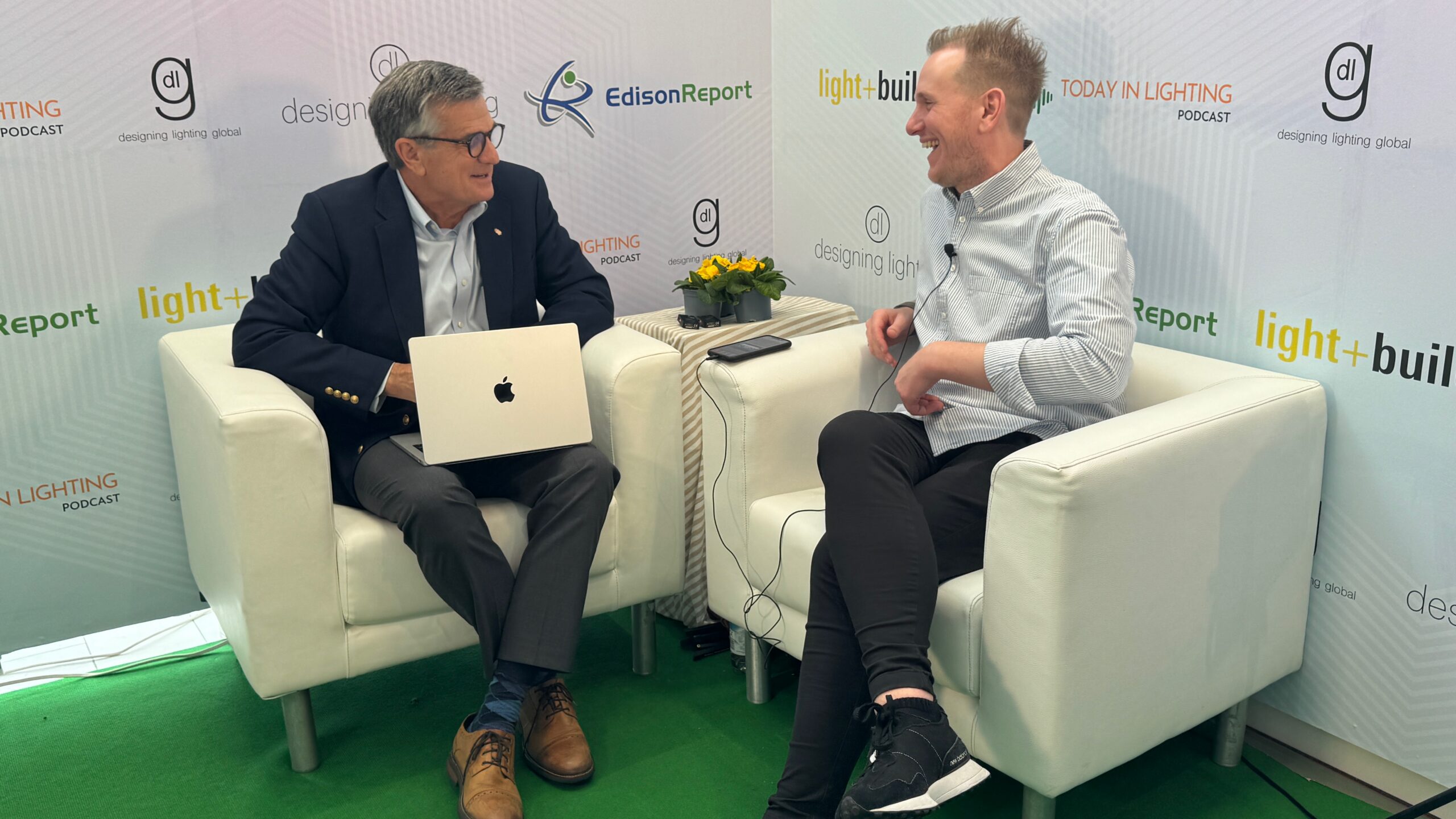
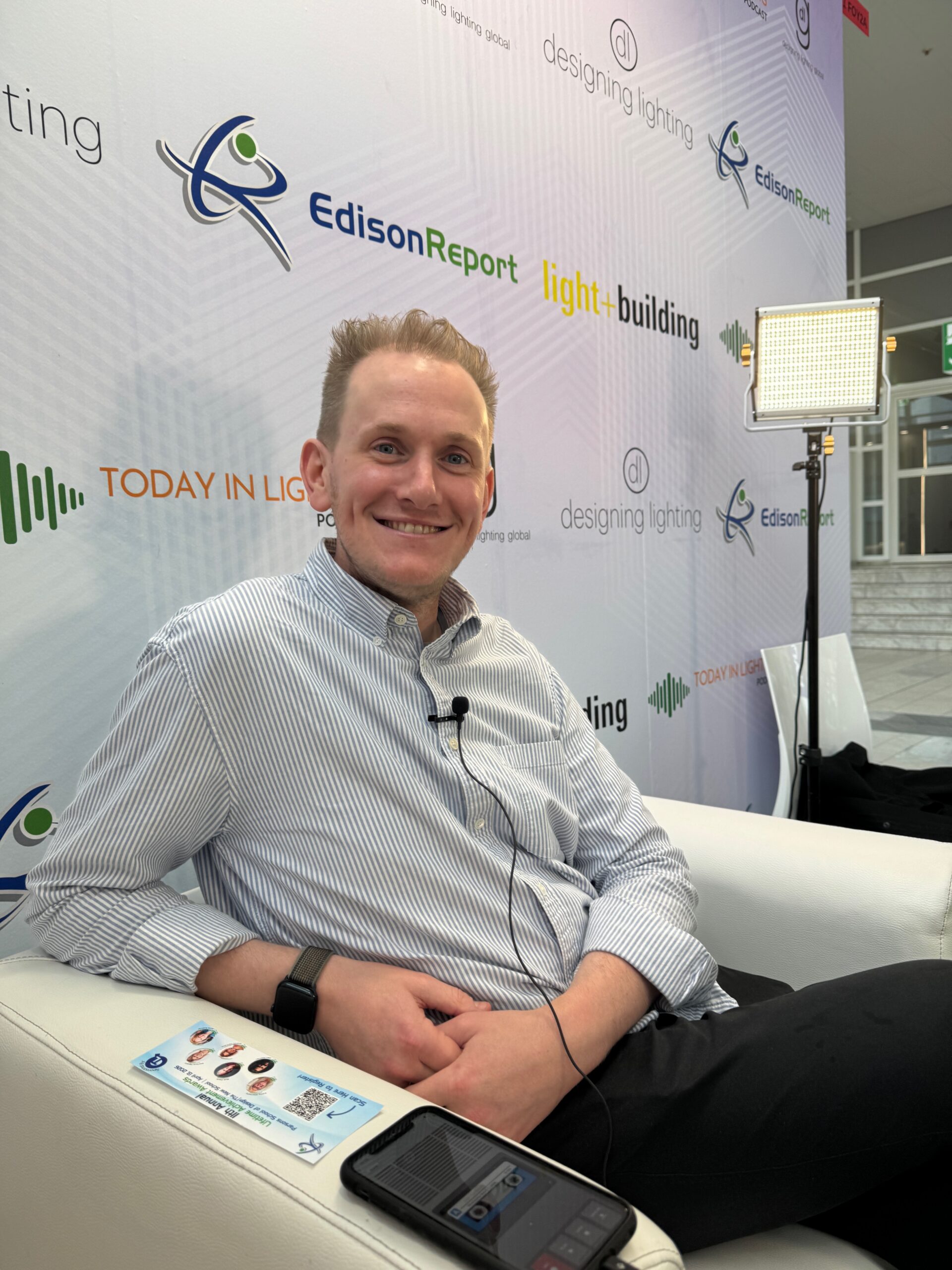
In the busy foyer of Hall 4.1 at Light + Building in Frankfurt, the EdisonReport studio hummed with constant conversation. Between interviews and passing crowds, Christopher Knowlton sat down and began with a simple but telling observation: the lighting design profession has come a long way—but it is far from settled.
Christopher Knowlton, CEO of the IALD, reflected on a decade of rapid transformation. “The profession is more established than it was 10 years ago,” he noted. “But it continues to evolve rapidly. There’s a lot of change continuously.”
A decade ago, the industry was just entering the LED era. Today, it faces a far more complex landscape shaped by digital tools, global expansion, and emerging technologies. “Change is probably the only constant,” Christopher added.
Growth Signals—and Lingering Gaps
One of the clearest signs of momentum is membership growth. Historically, the IALD has seen steady annual increases of about 5 to 6 percent. Last year, however, that number jumped to 14 percent.
“That’s a three-times increase,” Christopher explained. While it is difficult to isolate a single cause, he pointed to evolving bylaws and a broader openness within the organization as contributing factors.
Yet growth brings new questions. Chief among them: how many lighting designers are there, really?
“We have terrible data in our industry,” Christopher admitted. Estimates range widely—from 8,000 to as many as 30,000 practitioners worldwide. In many regions, people are doing lighting design work but don’t formally identify as lighting designers, which makes accurate counts difficult. I believe the number likely sits much closer to 8,000 than 30,000.
For educators and employers, the uncertainty is more than academic. Firms continue to compete aggressively for a limited pool of graduates. Programs at institutions such as Parsons and Penn State produce talented designers, but not in sufficient numbers to meet demand.
The Awareness Challenge
Christopher believes the issue begins long before university.
In countries like the United Kingdom, students begin narrowing career paths around age 14. At that stage, few are aware that lighting design is even an option. “Not many people say, ‘I want to be a lighting designer,’” he said. “But they also don’t know many of these specialist disciplines exist.”
Meanwhile, global technology companies actively invest in early education to attract future engineers and designers. By comparison, the lighting industry lacks both visibility and perceived cultural relevance.
“We’re competing with companies like Apple and Samsung,” Christopher observed. “And to some degree, we’re just not as visible.”
Still, he sees an opportunity. Through the IALD Education Trust, efforts are underway to develop accessible, inspiring materials that can be delivered by teachers and advocates. The goal is not technical depth, but awareness—showing young people that lighting design is creative, impactful, and viable.
Elevating the Role of the Designer
Beyond recruitment, the profession continues to grapple with perception. Many lighting designers feel their work remains undervalued, particularly in project hierarchies dominated by architects and developers.
In response, the IALD is focusing on outbound education. The organization is developing AIA-accredited content that members can deliver directly to architectural firms.
“It’s a train-the-trainer approach,” Christopher explained. “The more people delivering a consistent message, the more traction we get.”
Architects, who require continuing education credits, provide a natural entry point. From there, the conversation can expand to clients and owners—audiences that ultimately shape project priorities and budgets.
A Global Profession, Still Taking Shape
The IALD’s footprint now spans approximately 60 countries, reflecting a profession that is increasingly global yet still regionally distinct.
“The route to market is different,” Christopher said. The U.S. maintains its own unique model, while regions like the Middle East blend European and American approaches. Regulatory frameworks further influence how lighting design is practiced and valued.
Growth in Europe and Asia continues to accelerate. Later this year, the IALD will host Enlighten Asia in Singapore, signaling a long-term commitment to expanding its presence in the region.
AI and the Redefinition of Practice
If the past decade was defined by LEDs, the next may be shaped by artificial intelligence.
Christopher sees near-term gains in process automation. Routine tasks—such as scheduling, sequencing, and documentation—are likely to become more efficient. “Things will become more automated to achieve the same outcomes,” he said.
But the deeper impact lies in how projects are conceived and delivered. Traditional workflows—concept design, detailed design, tender, construction—are already shifting. Tools like Revit have pushed more work into earlier stages, while AI-driven visualization raises client expectations.
“Clients can now say, ‘I can generate a photorealistic image—why can’t you?’” Christopher noted.
The implications are profound. Large platforms are collecting vast amounts of project data, enabling increasingly sophisticated models. At the same time, questions of authorship, bias, and regulation emerge.
“Who gets specified? Who’s training the model?” he asked. “These are really big questions.”
Rather than predicting outcomes, Christopher frames AI as a necessary conversation. “Will lighting designers exist in 15 years?” he posed. “Not because we think they won’t—but it’s a good thought exercise.”
Business Pressures and Organizational Strategy
While technology reshapes design, the fundamentals of running a practice remain unchanged. Cash flow continues to challenge firms, particularly those working as subconsultants. Delayed payments, project cancellations, and staffing volatility can quickly destabilize operations.
For the IALD itself, the focus is on sustainable growth. Conferences and events remain primary revenue drivers, with recent years producing modest surpluses.
This year, however, marks a deliberate shift. The organization is investing in rebranding, staffing, and expanded programming, resulting in a planned deficit. “It’s controlled,” Christopher emphasized. “We’re investing now so we can grow.”
Measuring Impact, Not Just Activity
The same philosophy extends to the IALD Education Trust. With approximately $1.2 million in assets, the Trust has reassessed its programs to ensure alignment with its mission. “The easy thing would have been to spend money just to improve efficiency metrics,” Christopher said. “But the real question is—are we achieving our outcomes?”
It is a perspective that reflects a broader maturity within the profession: a shift from activity to impact, from growth to purpose.
Lighting design may still be defining its boundaries, but its trajectory is unmistakable. The profession is no longer emerging. It is evolving—quickly, globally, and with increasing consequence.
Register now for the IALD Enlighten Europe Conference, 18 & 19 JUN in Paris. www.iald.org/ee26