


The Numbers Are Everyone’s Business: A Guide to Open Book Management for Design Firms
How open book management is transforming lighting design firms from the inside out
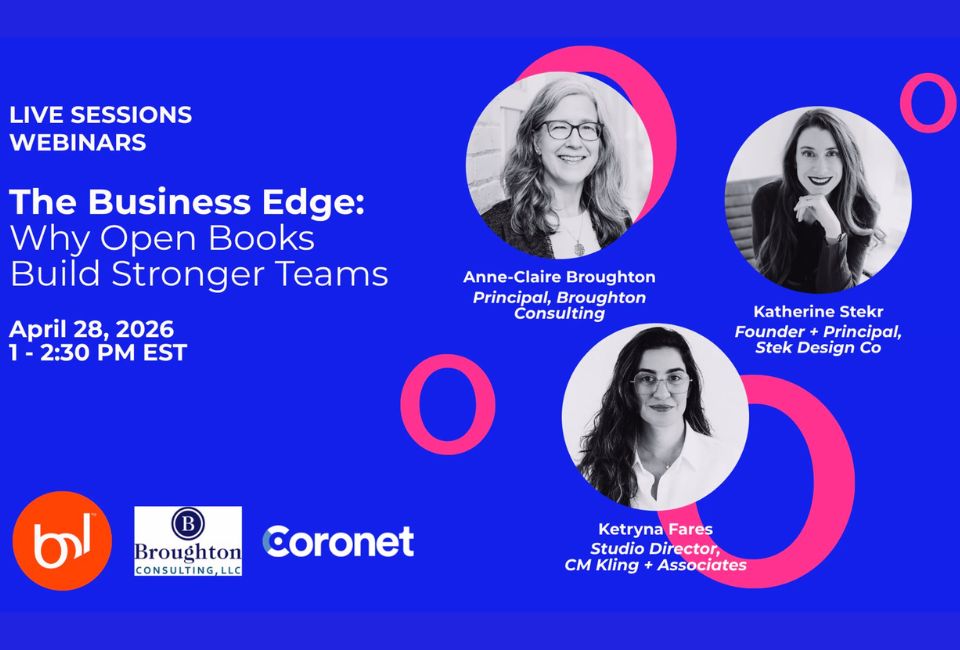
When Barbara Horton asks the question — “What if your team understood the numbers as well as the design?” — she’s drawing on years of firsthand experience leading HLB Lighting Design through one of the most transparent financial transformations in the industry. In a recent Business of Light webinar, she brought together open book management coach Anne-Claire Broughton and two former HLB designers, Katherine Stekr and Ketryna Fares, to unpack how financial transparency can reshape firm culture, strengthen teams, and fuel sustainable growth.
The verdict? The results go far beyond the bottom line.
The Problem: Two Worlds, One Firm
Most design firms operate with an invisible fault line. Owners lie awake thinking about cash flow, profitability, and client retention. Employees wonder about job security, compensation, and whether their work actually matters. These two groups are, in theory, working toward the same goal — but without shared information, they’re pulling in different directions.
“We really want everybody to be aligned, thinking about the same things,” says Anne-Claire Broughton, principal of Broughton Consulting and a certified coach with the Great Game of Business. “There’s so much less anxiety when everybody has the information.”
The solution she’s spent more than a decade implementing is open book management — an operating system that shares key financial data across an entire organization, teaches people how to understand it, and ties individual actions to company-wide outcomes.
The Origin Story: 89-to-1 Odds
The Great Game of Business began in 1983 when Jack Stack was sent to Springfield, Missouri to shut down a failing division of International Harvester. Instead, he fell in love with the people there, passed a hat among managers, mortgaged houses, and scraped together $100,000 to buy the plant outright.
The problem: the purchase price was $8.9 million. That’s an 89-to-1 debt-to-equity ratio — on a loan carrying 18% interest, from the 50th bank he approached (the loan officer was fired the next day).
Survival meant getting smart about finances — fast. So Stack did something radical: he taught everyone in the building how the business worked. Every metric. Every number. Every dollar.
The result? What started as a failing plant with 116 employees and $16 million in sales is now an employee-owned enterprise with over 1,700 employees, more than $700 million in revenue, and frontline workers who are millionaires. The last reported share price: $1,212.
The Framework: 10 Steps to Playing the Game
Broughton walked through the core structure of open book management, which she’s adapted for creative and service businesses across the country.
1. Start with willing leadership. Open book management doesn’t work if the people at the top aren’t committed. Many firms are accustomed to top-down decision making — and that culture has to shift first.
2. Share the why before the how.* Before any numbers hit a screen, the team needs to understand what this process is for and what’s in it for them.
3. Teach the numbers. This is where most firms stumble — not because the numbers are complicated, but because no one has ever framed them as stories. “Numbers are just stories about people and what we do every day,” Broughton explains. Who were the clients? How efficiently was time used? Did customers come back? The numbers answer all of these questions.
As a starting exercise, Broughton uses a simple dollar breakdown: for every dollar that comes in, what are the revenue lines? What are direct costs? What are overhead expenses? What’s left over? Most employees assume profit margins are enormous. In reality, the median across studied industries is just 6.5 cents on the dollar. Walmart operates at 2.4 cents.
4. Identify the critical number. Every firm has one metric that, at any given time, defines whether they’re winning. Often it’s profitability. For early-stage firms, it might be sales. That one number becomes the organizing principle for the year.
5. Create drivers. Once the critical number is set, the team maps out what every role — designers, marketing, finance, IT, admin — can do to affect it. A revelatory moment for many employees: an IT director who didn’t realize that every 30 minutes of downtime was costing the firm real money. An accountant who didn’t understand why getting invoices out fast mattered for cash flow. Once people see the connection, engagement shifts.
6. Play mini games. These are short-term, six-to-twelve-week improvement campaigns focused on one specific goal: meeting efficiency, social media output, timesheet compliance, accounts receivable. Each mini game has a goal, a scoreboard, and a reward. At one firm, a campaign called “No Spoon Left Behind” — tracking missing restaurant spoons across seven locations — eliminated $21,000 in annual waste, which offset $210,000 in revenue.
7. Build a stake in the outcome. The bonus plan isn’t a year-end surprise. It’s a clearly communicated system that everyone understands from the start, paid out quarterly so people see the connection between their effort and the reward. “We know exactly what we’re trying to do to hit that bonus,” Broughton says. “Everybody’s working towards it.”
8. Keep score — visibly. A condensed profit-and-loss scoreboard, posted where everyone can see it, tracks revenue, costs, and expenses alongside below-the-line metrics like net promoter scores, client referrals, and accounts receivable. What gets measured gets managed — and what gets put on the wall gets taken seriously.
9. Communicate in a weekly huddle. Every week, at the same time, the team gathers for 30–45 minutes: big-picture context from leadership, a forecast of where the month is heading, accountability check-ins, and shout-outs. The energy is forward-looking — 20% reviewing last month, 80% planning ahead. The goal is to catch problems in real time, not discover them in hindsight.
10. Involve everyone in planning. High-involvement planning means the strategy isn’t locked in a boardroom. Every team member understands the market position, the value proposition, the one-year and five-year goals, and the contingencies if the market shifts. When people understand the strategy, they represent the firm better — and generate better ideas.
From the Field: What It Actually Feels Like
For Ketryna Fares, who experienced open book management at HLB before moving on to her current role as studio director at CM Clink, the transformation was gradual — and then profound.
“Important decisions are made when the numbers are on the table. That’s the DNA of how a company works,” she says. “The fact that I wasn’t allowed in, or trained, or understood it — my naïveté kept me out of that room.”
She describes working at engineering and architecture firms where financial data was siloed or shared only in fragments — enough to sense something was happening, not enough to understand it. When HLB adopted the Great Game framework, the change wasn’t just informational. During the pandemic, while firms across the country kept their teams in the dark about financial health, HLB’s weekly huddle rhythm gave everyone a shared, real-time view of what was happening. Fear didn’t disappear, but it was replaced with clarity.
“Knowledge is power — having that understanding means you know what to expect. Everybody is in there trying their best,” she says. “And you can see the scoreboard and go, I helped with that. Even as the IT person.”
Katherine Stekr, who has since launched her own firm, Stekr Design, points to a specific moment in the reading that reoriented her thinking: Jack Stack’s “huts” analogy. The idea is that a business’s revenue streams should be separate enough — like huts spread across a field — that if one catches fire, the others survive. For a lighting design firm, that might mean maintaining parallel practices in hospitality, tenant improvement, and ecclesiastical work so that a recession affecting one sector doesn’t collapse everything.
“When I read that, I was like, oh my God, yes,” she says. “It also gave me permission to chase things that maybe didn’t go necessarily together but I was passionate about.”
That framework now shapes how she structures her own firm — and how she negotiates with clients. “I intimately understand how the fee was built and how it might get spent. It’s made me better at negotiation. I don’t seem shy about it.”
The Hesitation: Why Owners Hold Back
The word cloud generated during the webinar’s live poll told a familiar story. When asked why firms don’t share financial information, attendees typed: anxiety, confidentiality, fear, not sure what to share, too busy to mentor, don’t know why.
These concerns are legitimate, and Broughton doesn’t dismiss them. But she notes that in practice, sharing numbers tends to reduce fear rather than amplify it. “Once they start to share some of the key numbers and get people involved, it actually relieves some of their fear and anxiety.”
The deeper fear — that employees will misuse financial information, resent what they see, or leave — is often the opposite of what happens. Employees who understand the business feel more ownership over it. They self-regulate. They make better decisions. They stay.
Horton put it plainly from the owner’s perspective: “When you had to write the payroll and you looked at the amounts, it was frightening. There are days. Once we started this program, I think we all slept much better, because we felt like the responsibility was now shared by 70, 75 people — not just one or ten owners.”
There’s also a retention argument. Fares pointed to the math: if a skilled, experienced designer leaves, replacing her costs six months of time and roughly double her salary in onboarding. “I’d rather just keep her on staff, happy, and fulfilled.”
The Unexpected Upside
Across the conversation, a theme emerged that none of the panelists had necessarily anticipated at the outset: open book management reveals hidden talent.
When people understand strategy and have the information to act on it, they show up differently. A designer starts thinking like a business developer. Someone promoted from a junior role walks into a CEO’s office with a PowerPoint about new markets she’s been researching on her own. Someone who appeared to be a strong designer turns out to have COO instincts.
“We started to see people emerge from the experience and gravitate to something they really liked — that we didn’t know about,” Horton reflected.
The process also surfaces the opposite: people who, given full information, realize the firm isn’t the right fit. But that, too, is valuable. Turnover that comes from genuine misalignment is less costly than turnover driven by opacity and mistrust.
Where to Start
For firms not yet practicing any form of open book management, Broughton’s advice is deliberately unglamorous: start with a scoreboard.
“It does not have to be complicated. What are some really important metrics for your business that you need everybody to understand? Educate them, explain why it matters, and then have it somewhere prominently where you revisit it. Just start with that.”
From there, consider running a mini game around one specific improvement — meeting efficiency, timesheet submission, client referrals. Keep it to six to twelve weeks, make it visible, give it a reward.
The key is consistency over complexity. A simple scoreboard reviewed every week beats an elaborate system reviewed quarterly. The rhythm matters as much as the data.
A Question Worth Asking
One attendee — a designer named Andrew — asked a question that captures the frustration many people feel working in firms that don’t share financials: “I’m more likely to waste time on projects if I don’t even know what the fee is or how overhead is calculated.”
The panelists’ response was unanimous: that frustration is valid, and it’s costing firms real money.
As Fares put it: “When people are like, ‘I don’t know what my budget is on this project’ — that makes me really nervous. You don’t know where the guardrails are. You’re probably not gonna make any money.”
And Broughton offered a parting challenge: “If you’re interviewing at a firm, ask how they share financial data. If they’re very hesitant, that’s another tick on your pro-con list. It’s not to say they’re not a lovely place to work — but it helps you decide your future success.”
Resources
- The Great Game of Business by Jack Stack — the foundational text, available as a free audiobook
- A Stake in the Outcome by Jack Stack — the follow-up, highly recommended by all panelists
- For open book management coaching and implementation resources, visit the Great Game of Business website
The Business of Light is a community dedicated to engaging, educating, and elevating the next generation of lighting designers. Their next webinar — “Everything HR Wishes You Agreed, But Make It Fun” — takes place in June.