



Early in her career, Julie Dudley worked for a company that prided itself on having no employee handbook. Policies lived in one office manager’s head, and in scattered files on her computer. Then that manager took a three-month leave of absence. Questions about leave, performance, and discipline suddenly had no clear answers — and the answers people did remember didn’t always agree. “It caused a lot of unnecessary confusion,” Dudley said, “and it could have been prevented if the policies were documented and accessible to everyone.”
That story framed a recent Business of Light webinar on employee handbooks, led by Dudley — a former lighting designer turned HR consultant — alongside board member Nancy Stathes. Their message: a handbook isn’t corporate overkill for a small firm. It’s the difference between running a business by shared understanding and running one by memory.
Why a Handbook Matters, Even at One Employee
Dudley illustrated the problem with a simple image: a business owner starts out as an arrow pointing toward a mission and set of values. As the company grows, each new hire arrives as their own arrow — with their own assumptions about how work should be done, unless the owner has clearly stated otherwise. One employee might think jeans are fine for a client meeting; the owner might expect business casual. One might want a four-day week; another might expect unlimited vacation. Without documentation, these differences surface as awkward conversations after the fact instead of clear expectations up front.
“Even with one employee, that’s not too small to have a handbook,” Dudley said. The moment a policy question first comes up — how expenses are reimbursed, how PTO accrues — is the moment to write the answer down.
The efficiency case is just as strong as the cultural one. Dudley described a common scenario: an employee asks about a work-from-home stipend, and the owner says $500. A new hire asks the same question weeks later, and the owner — having forgotten the earlier answer — says $300. That inconsistency breeds resentment and eats up time the owner could have spent elsewhere. A documented policy means the answer is simply “it’s in the handbook.”
There’s also a legal dimension. A handbook is not required by law, but it forms what Dudley called a “compliance backbone” — evidence that required notices around anti-discrimination, anti-harassment, safety, and other regulations were actually communicated to employees. Stathes was blunt about the stakes: the size of a business doesn’t shield it from legal exposure once a claim is filed. Protecting the business has to be as important as growing it.
Emailed policies don’t substitute for a handbook, Stathes added, because inboxes get messy fast: “Not everyone is OCD and has 4,000 folders for each and every conversation.” A handbook centralizes what would otherwise be scattered across years of email threads.
What Belongs in a Handbook
At minimum, the panelists outlined several categories every handbook should cover:
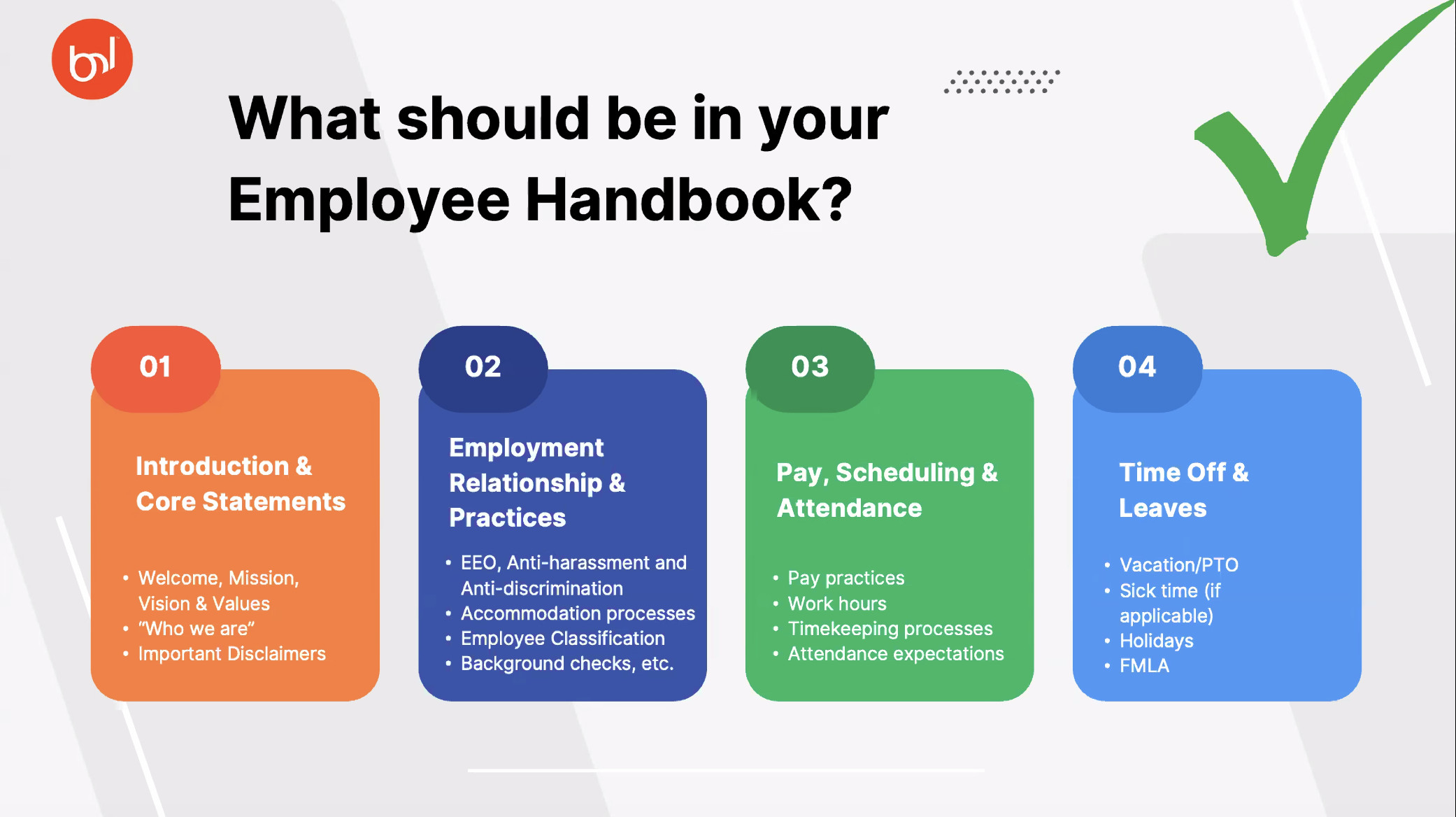
Introduction and company identity — a welcome message, mission and values, a high-level organizational overview, an at-will employment disclaimer (with attention to state-specific rules — Montana, for instance, differs from most states), and a statement reserving the company’s right to update policies.
Employment relationship and practices — equal employment opportunity and anti-discrimination statements, anti-harassment and anti-bullying policies with clear complaint procedures and non-retaliation protections, employment classifications (exempt/non-exempt, full-time/part-time/seasonal), and background-check practices.
Pay, scheduling, and attendance — pay periods and payday schedules, work hours and shift expectations, meal and rest break rules (which vary significantly by state — California in particular), timekeeping procedures, overtime policy, and attendance/punctuality expectations.
Time off and leave — vacation/PTO accrual and carryover, holidays, FMLA (for companies with 50+ employees), other statutory leave such as jury duty and military leave, and unpaid leave procedures. Some states require sick time to be tracked separately from general PTO.
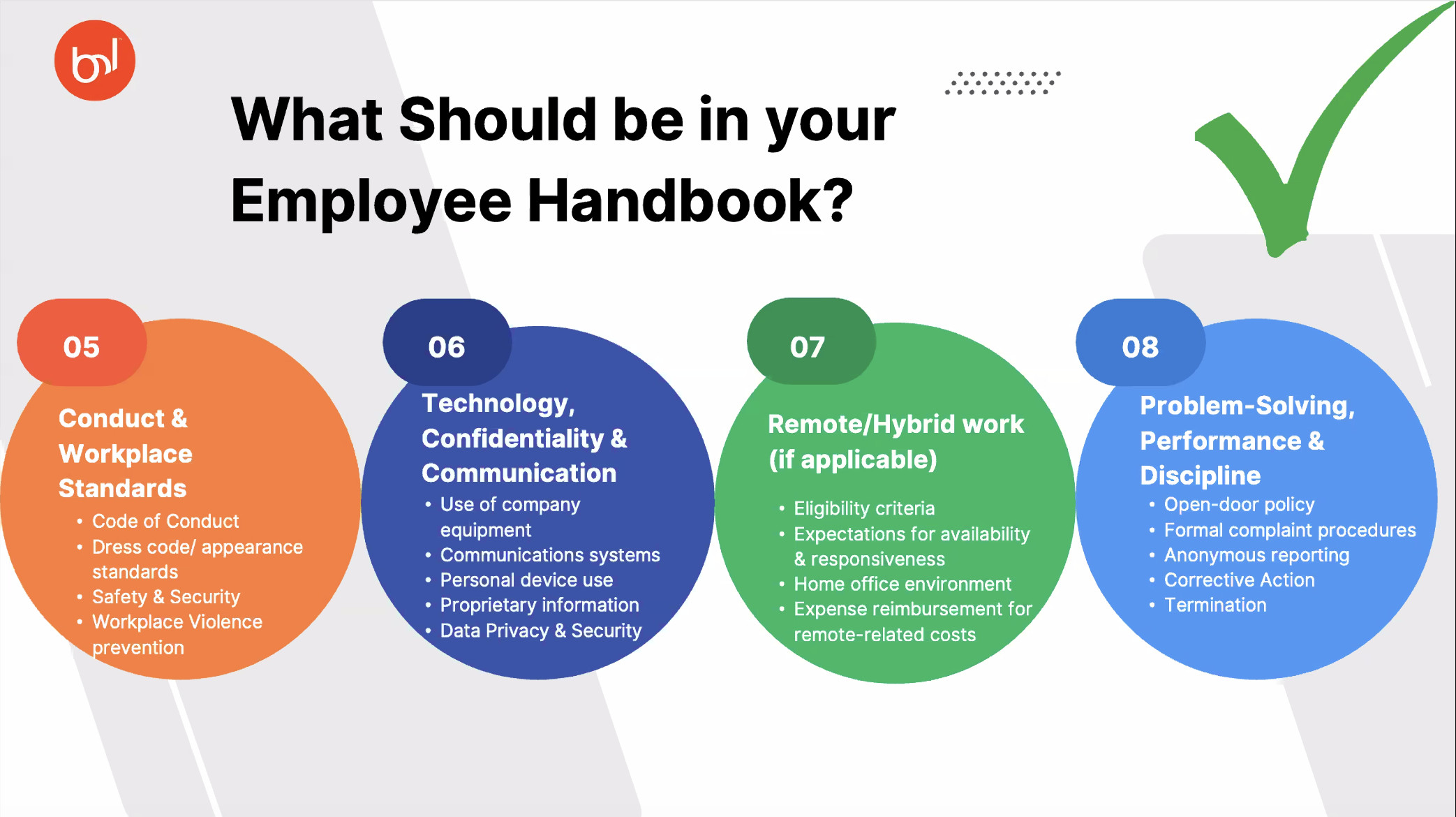
Conduct and workplace standards — code of conduct, dress code, safety and emergency procedures, substance abuse policy, workplace violence prevention, and weapons and smoking/vaping policies.
Technology, confidentiality, and communication — use of company equipment, email and internet policy, BYOD security requirements, social media expectations, confidentiality and data privacy (with attention to industry-specific rules like HIPAA), and remote/hybrid work eligibility and expectations.
Problem-solving, performance, and discipline — an open-door policy, formal grievance procedures, performance evaluation practices described at a high level, and a general approach to corrective action that acknowledges the company may bypass steps for serious offenses.
Ending employment — resignation notice expectations, return of company property, final paycheck timing (which should reference “as required by each state” for multi-state employers), exit interviews, and any post-employment obligations like non-solicitation.
Finally, every handbook needs a standalone acknowledgment page — signed and dated — confirming the employee received the handbook and agrees to comply with its policies, without implying they “agree” with every policy in a way that could be read as contractual.
What to Leave Out
Just as important as what goes in is what should stay out. The panelists flagged several categories of risk:
Language that creates unintended promises — phrases like “we will always” or “you will only be terminated for cause” — should be avoided in favor of softer, discretion-preserving language like “may.” The same caution applies to guaranteed hours, automatic raises, or rigid, step-by-step progressive discipline procedures, which can box a company in when a serious offense calls for immediate termination.
Specific turnaround commitments (“requests will be reviewed within 48 hours”) create obligations that may not always be met. “Reviewed in a timely manner” is safer language, unless a legal requirement dictates otherwise.
Detailed operational instructions — how payroll actually runs, step-by-step task procedures — belong in a separate standard operating procedure document, not the handbook. Including department-specific detail can also unintentionally suggest that parts of the handbook don’t apply company-wide.
Aspirational or outdated practices are a common trap: don’t claim “everyone gets annual performance reviews” if reviews happen irregularly, and don’t describe a policy that hasn’t actually been rolled out yet.
Complex legal language — arbitration agreements, class-action waivers, non-compete clauses — should live in separate, attorney-drafted documents rather than being pasted into the handbook. And policies copied wholesale from another company’s handbook need to be checked against your own actual practices and the states where you operate before they’re reused.
As Stathes put it, a handbook should read like a resource employees will actually use, not a wall of legalese: “Force sentences can completely take away all of the effort” of everything else you’ve built.
Balancing Culture with Compliance
One recurring theme was tone. A handbook should set a firm, consistent foundation — the same PTO policy, the same conduct standards for employee one and employee ten — while still leaving room for individuality. As Stathes explained, once the basics are locked in and applied equally, there’s plenty of room to make people feel valued through other means: recognition, compensation structure, growth opportunities. What shouldn’t vary by favoritism are the baseline policies themselves.
That same instinct applies to length. It’s tempting to try to write a policy for every conceivable situation, resulting in a hundred-page document nobody reads. The panelists’ advice: cover the essentials clearly, treat the handbook as a living document that will grow over time, and don’t let the fear of an incomplete first draft stop you from publishing something useful.
Legal Review and Ongoing Maintenance
A handbook can start as an AI-assisted or template-based draft, but it should always go through review by an employment attorney or HR compliance specialist before rollout — particularly for companies with employees across multiple states or countries, where wage-and-hour rules, leave laws, meal-and-rest-break requirements, and restrictive covenants like non-competes all vary. An employee is covered by the labor laws of the state where they live or work, regardless of where the company is headquartered.
Best practice is to review the handbook at least annually, and more often when laws, benefits, or organizational structure change. Companies should archive prior versions with effective dates (useful if a policy’s history is ever questioned in litigation) and keep a log of when each employee acknowledged the handbook — both at onboarding and after major updates.
Common triggers for an update include changes in employment law, new benefit programs, organizational restructuring, new workplace policies (like a shift to remote work), litigation or regulatory guidance, and expansion into new states or countries.
Distribution matters as much as content. Handbooks should be shared and discussed during onboarding — not just emailed and forgotten — and kept accessible on a shared drive or intranet so employees are always working from the current version. Managers, in particular, need to be trained on how to reference and apply the policies correctly, since a manager’s misstatement of a policy can spread faster than the actual document.
For staying current on legal requirements without constant attorney involvement, the panelists pointed to resources like state-specific labor law posters (including compact digital versions), payroll-service-provided compliance updates, and organizations like SHRM (Society for Human Resource Management), which offers state-by-state alerts when laws change.

The Bigger Picture
Asked how they personally use their own handbooks day to day, both panelists returned to the same idea: ownership. A handbook works best when the business owner treats it as a living reflection of the company, not a document to write once and file away. One firm even shares its handbook with prospective hires during recruiting, using it to showcase company culture and values alongside the job itself.
As Stathes summarized, an HR policy library “is not just a need to have, but really a critical part of your identity as a company.” Done well, a handbook does double duty — protecting the business legally while giving employees a clear, consistent sense of what it means to work there.
This article is based on a Business of Light webinar, “The Business of HR,” featuring Julie Dudley (HR consultant, former lighting designer) and Nancy Stathes (Business of Light board member), moderated by David and sponsored by Specialty Lighting Industries. Business of Light offers on-demand courses, live webinars, and a resource library for lighting industry professionals at businessoflight.org.