

Dallas Market Center Bets Big on Lighting Week
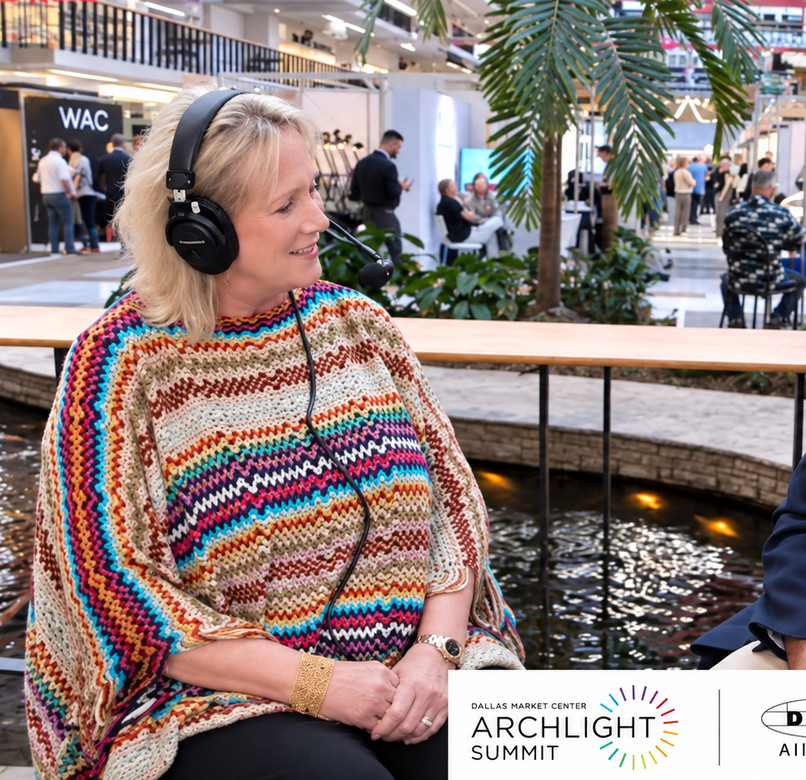
When I sat down with Cindy Morris, president and CEO of Dallas Market Center, during the 2026 ArchLIGHT Summit, the conversation quickly moved beyond the show taking place around us. Cindy was already focused on what comes next.
That is fitting for someone who repeatedly talks about watching where an industry is heading rather than simply reacting to where it has been. Next June, Dallas Market Center will put that philosophy to the test by bringing ArchLIGHT Summit and Lightovation together during what Cindy is calling Lighting Week in Dallas.
The decision reflects something she says Dallas Market Center has been watching for several years: the boundaries between decorative lighting, architectural lighting, interior design, hospitality and the specification community continue to blur.
Five Million Square Feet—and One Million Devoted to Lighting
Cindy began by putting Dallas Market Center into perspective. The campus encompasses roughly 5 million square feet, including about 1 million square feet devoted to lighting. It hosts trade events throughout the year while also operating daily as a design center.
“Dallas is the home of lighting,” Cindy told me, explaining why ArchLIGHT Summit fits naturally alongside the center’s long-established Lightovation events.
ArchLIGHT Summit was created for a primarily specification-oriented audience. Lightovation, by contrast, has traditionally centered on retail lighting showrooms. But Cindy says those distinctions are becoming less rigid.
More permanent Dallas Market Center lighting showrooms now participate in ArchLIGHT Summit. At the same time, manufacturers and attendees increasingly move between decorative and specification markets.
She pointed to WAC as a good example. The company operates a major permanent showroom at Dallas Market Center while also exhibiting on the ArchLIGHT Summit floor. Meanwhile, the center was simultaneously hosting the ASID Gather conference, underscoring how many design disciplines are converging in one location.
Following Where the Industry Is Going
Cindy described the strategy with a sports analogy.
She referenced Wayne Gretzky’s famous idea of skating to where the puck is going rather than where it has been. For Dallas Market Center, that means paying close attention to how buyers, designers and manufacturers are changing.
Architects are becoming involved in projects that may include more decorative product. Interior designers are taking on hospitality work. Builders are increasingly interacting with lighting showrooms. Hospitality professionals, architects and specifiers are moving into channels that once seemed much more separate.
Cindy also cited Dallas Market Center founder Trammell Crow’s belief that there can be as much risk in doing nothing as in doing something. That philosophy appears to be driving the decision to bring the shows closer together.
Lighting Week Dallas Takes Shape
The biggest news from our conversation was the scale of what Dallas Market Center is planning for June 2027.
ArchLIGHT Summit is scheduled for June 22–23, while Lightovation will run June 23–26. The events will overlap, giving attendees an opportunity to experience both architectural and decorative lighting during the same trip.
Other lighting organizations and groups will also be in Dallas during the week. Cindy noted that DALI-related activity will be present, while Lighting One plans to hold its annual convention during the same period.
Each event will retain its own identity. Cindy does not describe this as blending everything into one giant show. Instead, the strategy is to allow distinct audiences to maintain their own programs while making it easier for people to cross between them.
For buyers, that could create a compelling proposition.
Time is one of the industry’s most valuable commodities. A designer, manufacturer, representative or buyer who can accomplish several objectives during one trip may have a strong reason to put Dallas on the calendar.
“The feedback has been so positive,” Cindy said, adding that exhibitors have already responded enthusiastically to the concept.
Decorative and Architectural Lighting Continue to Merge
The crossover Cindy described is something I see regularly at designing lighting.
When we launched the magazine during COVID, our focus was architectural lighting. Yet when we cover hospitality projects today, decorative fixtures almost always become part of the story. Products from the third and fourth floors of Dallas Market Center frequently appear alongside specification-grade lighting because that is how projects are actually being designed.
Cindy sees the same trend from the market side.
She mentioned interior designer Charlotte Moss, who was appearing at Dallas Market Center and had discussed a roughly 230-room hotel project in Houston. Projects like that illustrate how traditional categories can quickly overlap. A hospitality project may involve architecture, decorative lighting, specification lighting and interior design simultaneously.
The industry may still organize itself around categories, but many projects no longer do.
The Business Case for Dallas
Our discussion also turned to something exhibitors frequently mention when talking about Dallas Market Center: the economics of exhibiting there.
Unlike many convention environments, Dallas Market Center operates in Texas, a right-to-work state. Cindy emphasized the center’s efforts to make exhibiting as cost-effective as possible and discussed its relationship with GES.
I told her that, as the owner of a relatively small publishing company, I understand the problem. At some trade shows, simply moving magazines onto a show floor can generate thousands of dollars in drayage charges.
Dallas also has a geographic advantage. Love Field is only a few miles from Dallas Market Center, while Dallas Fort Worth International Airport provides extensive national and international access. For many attendees, the city is relatively easy to reach from either coast.
Once attendees arrive, Cindy argues that the building itself is designed around conducting business. Food, shipping services and other amenities are located within the complex, and numerous hotels sit nearby.
Her goal is simple: eliminate as much friction as possible.
“It’s all about helping people do more business as cost-effectively as possible,” she said. Pasted text.txtTXT
A Broader Definition of the Lighting Industry
What struck me most about the conversation was that Cindy is not simply trying to make two trade shows larger. She is responding to a broader structural change in lighting.
For years, our industry has separated itself into categories: architectural versus decorative, specification versus residential, designer versus retailer. Those distinctions still matter, but the walls between them are getting lower.
A lighting designer may specify decorative fixtures. An interior designer may influence architectural lighting. A showroom may serve builders, hospitality firms and designers in addition to traditional retail customers. Manufacturers increasingly serve several of those audiences at once.
Dallas Market Center believes that bringing those communities together creates business opportunities that would otherwise be missed.
The real test will come next June, when ArchLIGHT Summit and Lightovation overlap for the first time as part of Lighting Week Dallas.
If Cindy’s read on the market is correct, the industry may already be moving in that direction anyway. Dallas is simply trying to meet it there.
Watch the entire video here.