

Mariana Figueiro on Circadian Lighting and Human Health
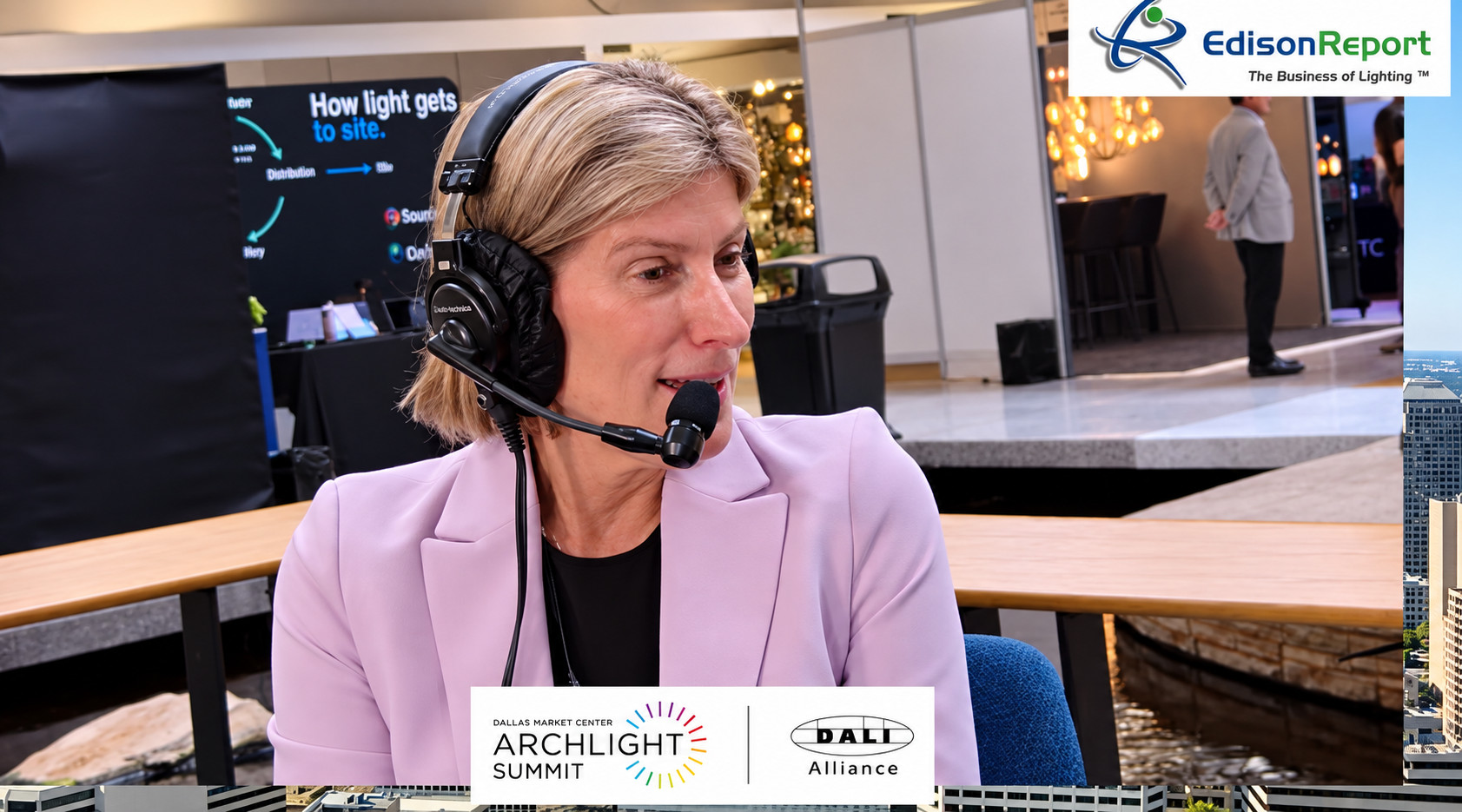
At the 2026 ArchLIGHT Summit in Dallas, I sat down with Mariana Figueiro, PhD, Professor and Director of the Light and Health Research Center at the Icahn School of Medicine at Mount Sinai, immediately following her presentation on lighting and human health.
I have interviewed Mariana many times over the years, but this conversation struck me because her message to lighting designers has become increasingly direct.
We know enough to act.
That was essentially the message she delivered during her ArchLIGHT session. The lighting industry has spent years debating terminology, metrics, circadian entrainment and exactly how much light constitutes the proper “dose.” Mariana is not suggesting that the science no longer matters. Quite the opposite. Her career has been devoted to the science.
But she believes the pursuit of perfect answers can become an excuse for doing nothing.
“Do No Harm” Means Doing Something
During Mariana’s presentation, a lighting designer raised a concern that many designers probably share: Who am I to prescribe a dose of light that could affect someone biologically?
Mariana challenged the premise. She compared it to medical research. We do not abandon potentially beneficial treatments because they do not work identically for every individual. Likewise, we would never tell people to avoid daylight because researchers cannot predict precisely how every person will respond.
Her larger point was simple. Designers already affect people with light, whether they consciously design for human health or not.
“If you think about it, you might be doing harm with what you’re doing right now,” she said. Then came perhaps the best line of our interview: “The do no harm means do something.”
That could easily become a rallying cry for the lighting industry.
Light, Sleep and 9/11 Rescue Workers
One of the most fascinating portions of Mariana’s presentation involved research with World Trade Center rescue workers.
Mount Sinai follows a cohort of 9/11 responders, many of whom experience sleep problems and mild cognitive impairment. Mariana explained that researchers wanted to examine whether light could be used to improve sleep and, consequently, cognition.
The reasoning was based on earlier work showing that improving sleep can improve cognitive outcomes.
“And that’s exactly what we found,” Mariana said. The initial study was small, and at the time of our interview the team had submitted a proposal to expand the work into a larger randomized clinical trial.
The implications extend far beyond this particular population. Mariana’s laboratory continues to investigate light in connection with conditions ranging from Parkinson’s disease and Alzheimer’s disease to cancer and cognitive impairment.
That growing body of research makes the industry’s hesitancy particularly frustrating to her. While scientists continue producing evidence, she sees relatively little change in everyday lighting practice.
Red Light: Alertness Without Suppressing Melatonin
Mariana also discussed something I found particularly interesting: red light.
We have long heard that light can function almost like a cup of coffee by increasing alertness. But Mariana explained an important distinction between red light and the shorter wavelengths commonly associated with melatonin suppression.
Bright white light, and particularly short-wavelength light, can suppress melatonin at night. Mariana explained that the response can begin relatively quickly after exposure.
Red light is different. According to Mariana, red light can increase alertness without producing the same melatonin-suppression response.
That opens intriguing possibilities for environments where people need to remain alert at night without unnecessarily disrupting the biological signals associated with darkness.
She also discussed an area she wants to investigate further: pulsing the exposure rather than leaving red light on continuously.
Her hypothesis is that people may become desensitized to the stimulus. She compared it to walking into a dark room and suddenly turning on a bright light. Initially, the light seems extremely bright. After a while, we adapt.
Mariana suspects something similar may happen with red light.
Rather than providing the stimulus continuously for an hour, perhaps exposure should alternate—on, off and on again—to repeatedly sensitize the system.
She was careful to emphasize that this remains a hypothesis.
“I don’t have data on that,” she told me, “but I have a feeling that that’s what we need to look into next.”
Has Circadian Lighting Lost Its Momentum?
I asked Mariana a question that I think our industry needs to confront: Are we actually making progress in getting circadian principles specified? Her answer was immediate. “I don’t think so, Randy.” In fact, she believes the industry is talking about circadian lighting less than it once did.
Part of the problem, she said, was that circadian lighting became almost synonymous with tunable lighting. Those are not the same thing.
Then came the metrics. Melanopic EDI. Circadian stimulus. Melanopic light. Different terminology and different ways of describing biological responses to light piled on top of one another.
The science may be legitimate, but to many practitioners the message became unnecessarily complicated. Mariana’s advice is refreshingly straightforward: forget about the metrics for a moment and use lux.
She acknowledged that lux is not scientifically the ideal metric for describing every biological effect of light. But designers can work with familiar measurements and convert them appropriately. “We got just hung up too much on that,” she said. “It really turned people off.”
That is unfortunate because, as Mariana pointed out, researchers are simultaneously generating meaningful data involving Parkinson’s patients, cancer patients, Alzheimer’s disease, cognitive impairment and World Trade Center responders.
The science continues moving forward even as the lighting industry seems to have become less comfortable talking about it.
Start With Nursing Homes
Our conversation then turned personal.
My father-in-law recently moved into a nursing home, and I told Mariana that the lighting is horrendous. Having spent my career around lighting, one of my fears is eventually finding myself in a nursing facility surrounded by terrible light. Mariana did not hesitate. “Start there.”
For designers who remain uncomfortable incorporating light-and-health principles into projects, she believes nursing homes are an obvious opportunity. Unfortunately, there is a problem: many nursing homes have limited budgets. That led Mariana to another point she had discussed recently—perhaps researchers need to spend more time talking to architects in addition to lighting designers.
Lighting designers are often involved in higher-end projects. Architects and architecture-engineering firms, however, touch huge numbers of ordinary offices, healthcare facilities and nursing homes.
Those everyday buildings may be where some of the greatest opportunities exist. And improving lighting for health does not necessarily require an expensive tunable system. “You can do better than what they’re doing right now without having to be fancy,” Mariana said.
Architecture itself can contribute. Furniture can contribute. Daylight and relatively simple lighting decisions can contribute. “It doesn’t have to be more expensive,” she said. “People just need to get out of their comfort zone.”
Where the Research Goes Next
Despite funding challenges, Mariana and her colleagues have a significant amount of work underway.
Her team recently completed a large randomized clinical trial involving people recovering from long COVID, studying sleep and the impact of light alone as well as light combined with oral melatonin. Mariana could not discuss the findings yet, but promised we would hear more once the results are published.
The Center is also beginning to explore mitochondria and questions surrounding how light dose should be measured in that emerging field.
Other work includes research into myopia with the New England College of Optometry, pulse oximetry and sleep apnea, as well as Mark Rea’s continuing research involving plants.
Mariana also praised WAC for its commitment to education. She has been participating in a webinar series for the company, and one session reached the Microsoft Teams limit with more than 1,000 participants.
That level of interest suggests something important. People still want to understand light and health.
Perhaps the problem is not a lack of interest. Maybe we have simply made the subject sound harder than it needs to be. After decades of research, Mariana’s message to designers at ArchLIGHT Summit was remarkably uncomplicated.
Stop waiting for perfection. Stop allowing terminology to paralyze the conversation.
Understand the research, apply what we know and continue improving as the science evolves. Or, as Mariana put it much more succinctly: Just do it.
Watch the Full Interview
Mariana Figueiro joins Randy Reid at the 2026 ArchLIGHT Summit in Dallas to discuss light and human health, circadian lighting, red light, sleep research, 9/11 rescue workers, nursing homes and the future of lighting research.
Read more about the ArchLIGHT Summit:
ArchLIGHT Summit Education: Beyond the Show Floor
ArchLIGHT Summit: Strong Start and WILD Welcome