


A decade after its first award, the IESNYC Merit Scholarship has helped shape a generation of lighting leaders, including the section’s own president.
When Zachary Pearson, IALD, LEED AP BD+C, MIES, and I began planning a November feature for The Spec, he had a theme in mind before I did. It was Thanksgiving, he said, so why not take the word apart? The thanks would go to the people who saw a spark in him as a graduate student. The giving would celebrate what they and their committee have built for the future of lighting.
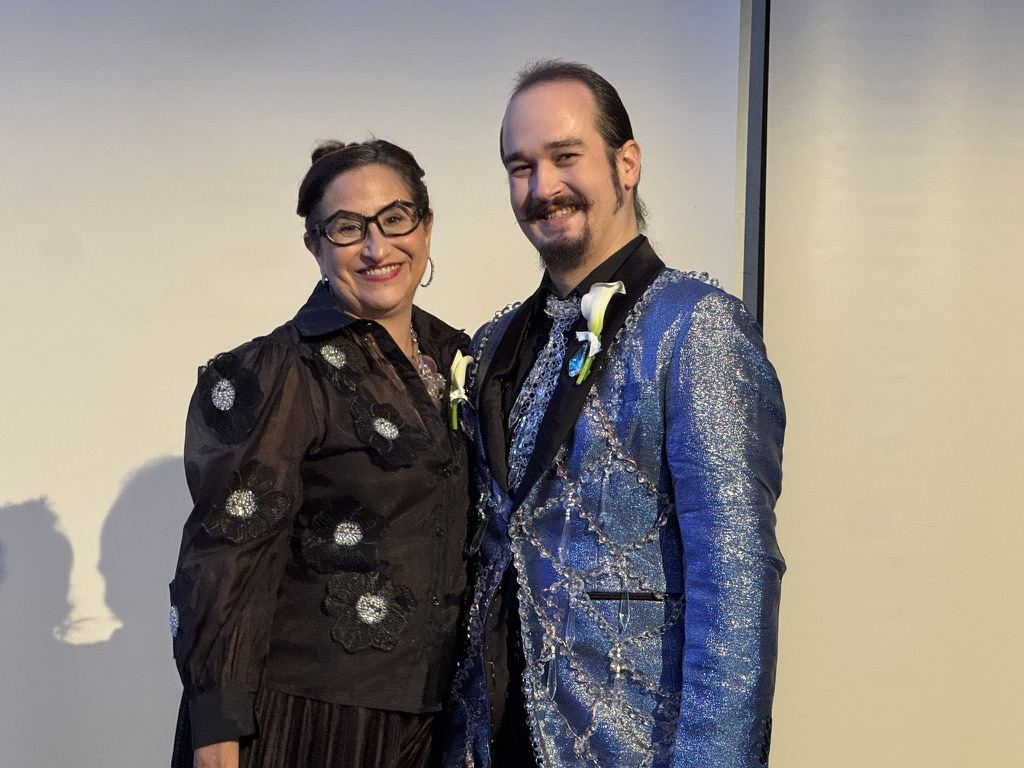
Two of those people are Addison Kelly, IALD, MIES, of US Lighting Consultants and Mike Barr, MIES, of Lutron, longtime members of the IESNYC Merit Scholarship committee.
Zachary received the scholarship in 2018. Today he is president of IESNYC. The four of us gathered on a video call to talk about how a section scholarship became one of the most consequential investments in New York lighting.
A Bold Idea, Quickly Realized
The scholarship was the brainchild of Caleb McKenzie, LC, IALDA, MIES, Addison’s then-partner at US Lighting Consultants and a past president of the section. As Addison recalls, Caleb walked into the office one day in 2015 and announced he had a terrific idea: the New York section should have a scholarship. It was a period of economic downturn. Addison’s reply was dry. “Remind me when we haven’t been having an economic downturn.”
Addison remembers a years-long, slogging process to win over the section’s board. The record suggests otherwise. Addison went back to the shared drive where the two kept their documents and found that the idea took shape in February 2015 and was announced that October. The first award followed in 2016. “We’re both old and don’t rely on our memories for anything,” Addison says with a laugh.
From the beginning, Caleb insisted on scale. If the section was going to do this, Mike recalls, it should be meaningful: not a $500 award, but $25,000. At its launch, the award was reported as the first time an IES section had supported education to that extent. The scholarship is open to full-time, first-year graduate students in architectural lighting at accredited programs in New York State, and it has helped recipients defray the cost of their education while drawing more talent into the field.
Merit, and Only Merit
The committee settled early on the hardest question: how to choose among students it had never met. The first filter belongs to the schools. Each accredited program forwards its very best, often more than one, so the judges never have to guess at a student’s creative spirit from a few pages of text. In a typical year, Addison estimates, about ten applications arrive. Mike notes that the number rises and falls from year to year, for reasons no one has quite pinned down.
Then comes the step Mike calls a fundamental tenet. Every application is redacted to remove any personal or identifying information. Addison adds that any phrase or sentence suggesting financial need is removed as well. Need is not considered. “We don’t need to know it, and we don’t want it to influence,” Addison says. What the five judges read are first-person essays, evaluated for innovation, leadership and the kind of determination that marks someone who will go further. The judges themselves are seasoned professionals, people who have hired designers and served at many levels of the IES, the IALD and other organizations.
The deliberation has its own rhythm. Applications are shared in advance, and each judge arrives with a ranked shortlist. Often one candidate tops nearly everyone’s list. But the committee does not stop there. Sometimes a student who flew under the radar for most of the panel finds a passionate champion, and the conversation turns. “It’s not like we take a vote and the most votes wins,” Mike says. “It really is a consensus exercise.” The first few years of judging took place in person, over stacks of paper. The pandemic moved it online, and the format worked so well that it stayed, though the committee still gathers over lunch at a Lutron showroom.
From Recipient to President
If the committee wanted proof that its method works, Zachary is it. “Is there a better example?” Addison asks. “Could there possibly be a better example?”
Zachary was a master’s candidate in lighting at Rensselaer Polytechnic Institute when he received the scholarship in 2018, the program’s third year. His thesis explored community engagement through civic light art, and the award let him take that research on the road, to light festivals in Canada, Amsterdam and France. It was, he says, foundational support that allowed the thesis to become everything it could be.
What followed was a swift ascent. The year after his award, Zachary was invited to join the committee reviewing the next round of applicants. Soon after, he joined the section’s Board of Managers, where he found his passion and launched NextGen, an entirely new program to bridge the gap between students and emerging professionals. He then served as vice president, learning the role under then-president Shoshanna Segal, CLD, LC, IALD, LEED AP, MIES, and the past presidents who remain on the board, and was elected president at 29. He is now 31.
I asked whether that path was unusually fast. Zachary’s original application, Mike says he already showed a long record of accomplishment at a young age. When Zachary was weighing the vice presidency, he and Mike sat down to discuss the commitment and journey ahead. Mike asked him how he would manage volunteers much older than himself. The answer has stayed with Mike ever since: “That’s what I’ve been doing all my life.” Seen in that light, Mike says, the presidency is not an exception. “It’s just another one of those accomplishments.”
Zachary sees his age not as a hurdle, but as a vital part of his mission. His election, he says, speaks volumes about a New York lighting community ready for a fresh look toward the future, and he is quick to return the compliment to Addison, Mike and the section’s leadership for putting their trust in him.
An Ecosystem of Giving
I asked whether the scholarship ranks among the section’s largest expenses. Zachary reframed the question. “I would say it’s one of our largest investments in the future,” he says, “but it certainly is not an anomaly.”
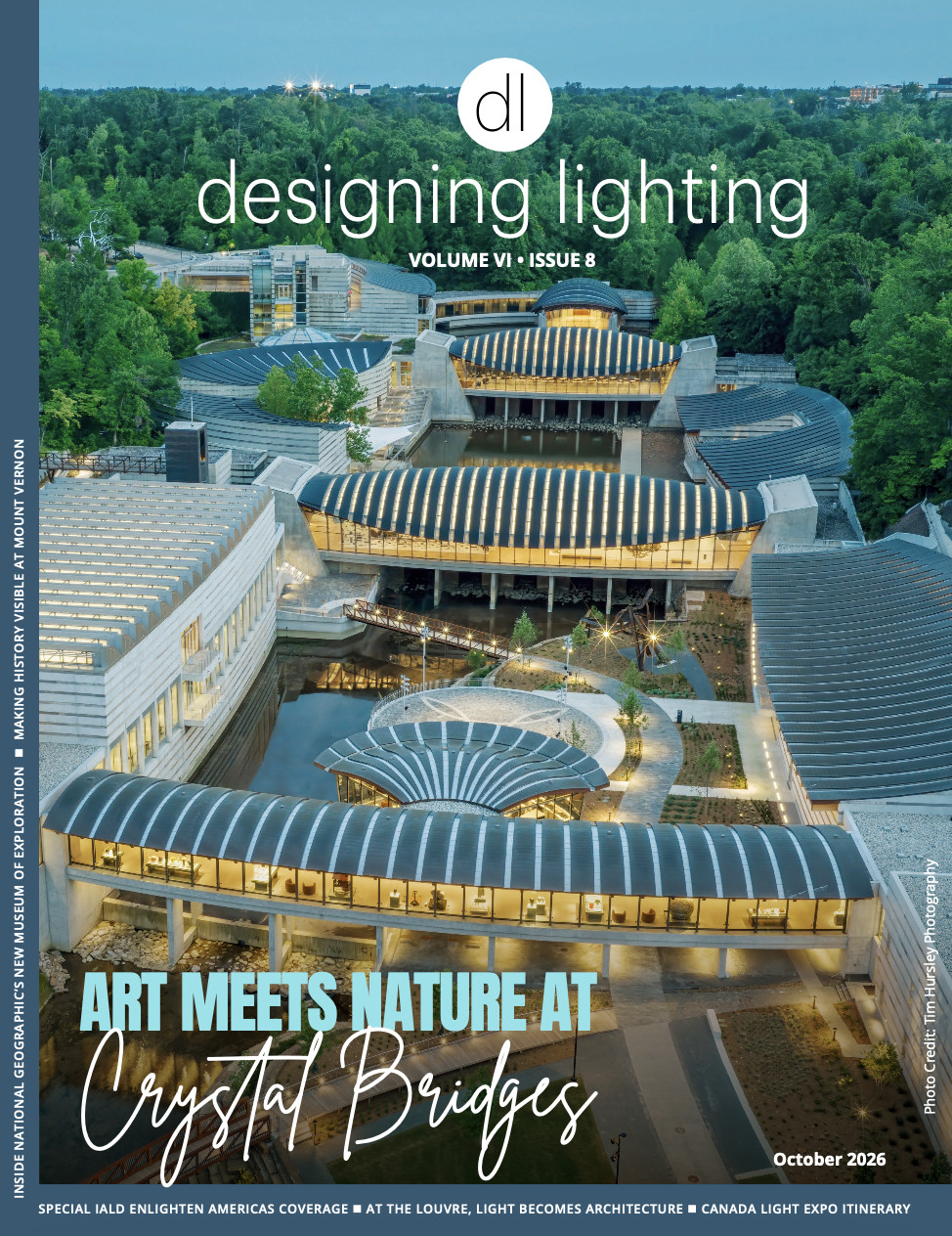
The Thesis Prize is one of many examples of the section’s investment in the future. Each year, the graduate lighting programs at the New York School of Interior Design, Parsons School of Design at The New School and the Lighting Research Center at Rensselaer each identify a student whose thesis is exemplary, and the section awards that student a stipend. These programs may go along quietly, Mike says, but the industry notices and is grateful. designing lighting (dl) has published several of those theses over the years.
The Guiding Lights Circle, an annual mentorship program conceived by Jean Jacques, Executive Vice President of SDA Lighting & Controls, and now led by Nathalie Faubert, Senior Associate at Cline Bettridge Bernstein Lighting Design, pairs established professionals with emerging designers. It begins with what Zachary describes as a speed-dating event, where participants rank the people they would most like to work with. The pairs then meet throughout the year with IES support, giving young designers a trusted voice in the industry beyond their own office. The program is in its third year, Mike believes, “but I wouldn’t bet a kidney on it.”
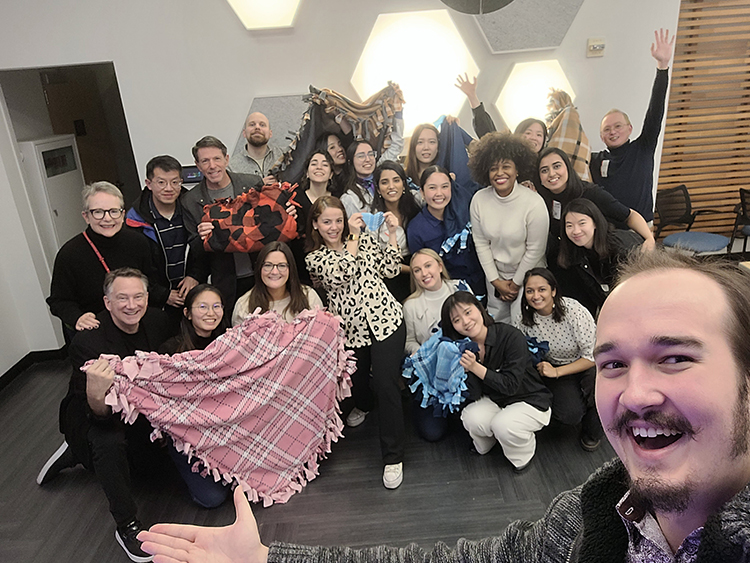
Next Gen Winter 2023
Then there is NextGen, the committee Zachary founded and the program he holds closest to his heart. It bridges what were once separate student and emerging professional programs, easing the move from classroom to career and giving young designers a network beyond the walls of their own firms. The committee hosts six to eight events a year. Slice of Light is timed to Manhattanhenge, pairing a conversation about daylight with live sketching of the sunset in the street. Winter Warm-Up, held in February or March, draws 20 to 30 young minds to hear professionals from across the industry while they hand-tie blankets for the city’s senior centers. The most ambitious is the Bowery District Dash, an Amazing Race-style scavenger hunt through a half dozen showrooms in the Bowery Lighting District near Canal Street, ending in a party.
Finally, Addison wants to be clear about the Richard Kelly Grant. It is very strongly aligned with the section and administered by its own committee, but it is distinct from the Merit Scholarship. “The Kelly Grant isn’t a scholarship,” Addison says. “It’s open to anybody 35 and under.”
A Template Worth Copying
Before we ended the call, Addison raised something she and Caleb had discussed many times. From the start, the two had hoped the Merit Scholarship would become a template. The New York award is limited to students in New York State, but there was no reason a section in Boston, Los Angeles or Boulder, Colorado, with schools teaching architectural lighting, could not create their own. It would not need to match $25,000. “If you were a student, you wouldn’t turn down $10,000 if somebody offered it to you,” Addison says. That hope has not yet taken root elsewhere, which Addison suspects may simply be a matter of messaging.
Zachary opened our conversation by pulling Thanksgiving apart. By the end of the hour, the two halves had folded neatly back together. The scholarship that recognized his promise in 2018 has since been repaid many times over, first from a seat on the review committee, then on the board, and now in the president’s chair, where he spends his volunteer hours building the very programs that will carry the next student forward. That was the wager Caleb and Addison placed in 2015: invest in one exceptional student, and the industry collects the dividend for decades.
So consider this an open invitation to every section with a lighting school in its backyard and a little money to invest. New York has already written the playbook, and the committee seems eager to share it. The thanks will take care of itself. Just ask Zachary.
My thanks to Zachary, Addison and Mike, all volunteers, for their time and for everything they do for the New York lighting community.