

Andrea Hartranft’s Three Scenarios for the Future of Lighting Design
At the ArchLIGHT Summit closing keynote, Andrea Hartranft challenged the industry to consider three very different futures: the disappearance of the independent lighting designer, designers moving into product sales, or a market where everyone finally charges for lighting design.
Andrea Hartranft, managing principal of Hartranft Lighting Studios and immediate past president of the IALD, used her closing keynote at the ArchLIGHT Summit to ask the industry a question that was deliberately uncomfortable: what happens when the race to the bottom is over?
Rather than offering a tidy prediction, Andrea organized the heart of her presentation around three scenarios. Each addressed the same underlying problem from a different direction: lighting design is under pressure from commoditization, bundled services, changing business models and technology. Her goal was not to declare which outcome was inevitable, but to give the industry a framework for discussing what may come next.
Scenario One: What If the Lighting Designer Goes Away?
Andrea’s first scenario was the most dramatic. What if professional lighting design, as a separate discipline, gradually disappears?
She reminded the audience that lighting design is a relatively young profession. The IALD was founded in 1969, and before that much of the work now associated with professional lighting design lived within engineering, architecture and related disciplines. That history, Andrea argued, matters because a profession that emerged fairly recently can also lose ground if its value is not clearly understood.
Today, architects increasingly keep some lighting decisions in-house. Interior designers often control decorative lighting and fixture selection. Reps may provide layouts as part of a product sale, while AI-assisted software can already produce compliant lighting layouts from basic room information. Andrea was careful not to characterize any of these groups as enemies. Her broader point was that unprotected professional territory tends to be absorbed by adjacent disciplines.
The danger, she suggested, may not be a catastrophic failure that everyone notices. A building without a professional lighting designer may still function. The lights will turn on, code may be met and the project may appear acceptable. Yet glare control, architectural integration, visual comfort and other qualities could slowly erode. Occupants may feel that something is missing without ever knowing why.
That kind of gradual decline may be more dangerous than an obvious failure because it risks becoming normal.
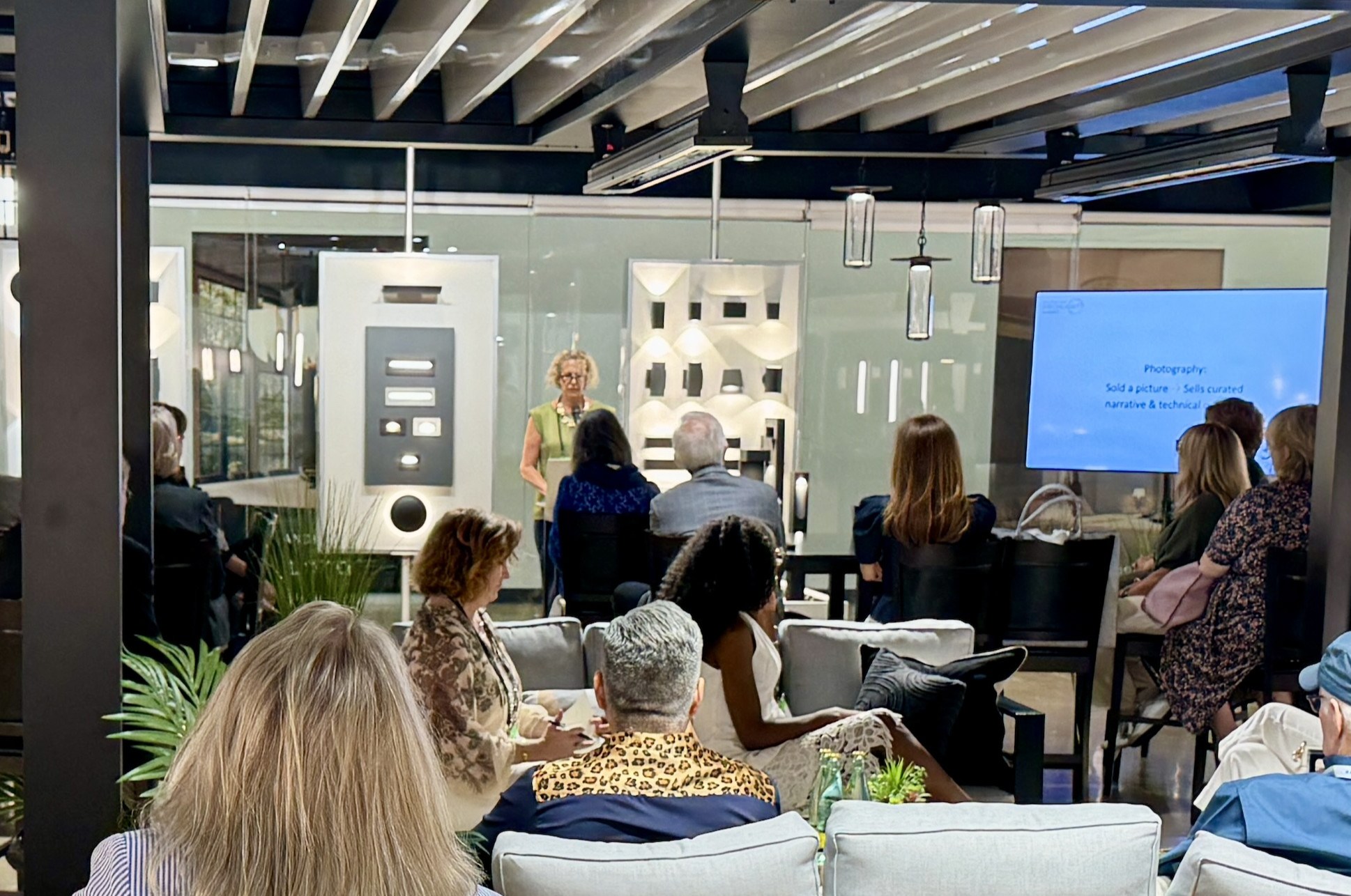
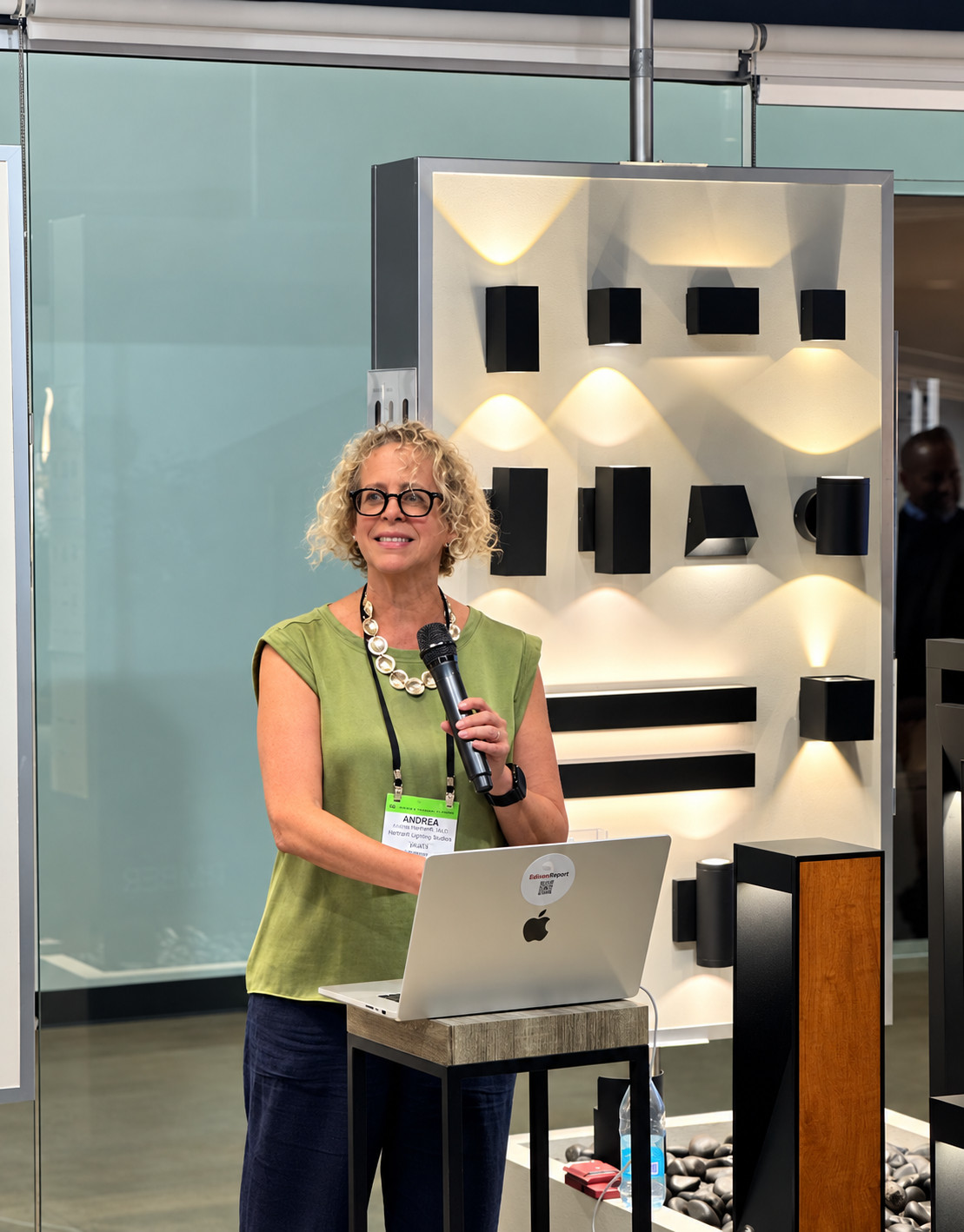
Andrea Hartranft delivers the closing keynote at the ArchLIGHT Summit in the Europfase showroom
Scenario Two: What If Designers Start Selling Product?
Andrea’s second scenario may be the closest to what is already happening in the market.
What if lighting designers increasingly make money from the products they specify?
Instead of relying only on a professional fee, a designer could earn margin on luminaires. In some cases, that revenue might reduce the design fee. In others, it could replace it altogether. Andrea described this as the mirror image of free design on the rep side. When a rep provides design services to help win a product order, the rep moves into part of the designer’s territory. When a designer begins earning margin on the product, the designer moves into territory traditionally occupied by reps, distributors and contractors.
Andrea did not automatically reject the idea. In fact, she pointed to one potential advantage: a designer whose revenue depends partly on the specified product surviving value engineering has a stronger financial incentive to protect that specification all the way through construction.
That could align the designer more closely with the final installed outcome. At the same time, it raises difficult questions about transparency, ethics and disclosure. If a designer recommends a fixture while also earning money from its sale, should the client know exactly how that compensation works?
Andrea compared the issue to financial advising, where commission-based and fee-only models have existed side by side. Over time, clients began asking a simple question: how do you get paid? She suggested that lighting may eventually face the same expectation.
That may be the most significant issue in this scenario. The industry is already experimenting with new revenue models, but it has not yet agreed on common rules, standard disclosure practices or even consistent language to describe them.
Scenario Three: What If Everyone Charges for Lighting Design?
Andrea’s third scenario was the most aspirational: what if every provider of lighting design charged a visible, standalone fee?
No free layouts bundled with product sales. No hidden subsidy. No design included simply because a client purchased fixtures.
Andrea acknowledged that this may be the least likely of the three scenarios, but she argued that it is still worth asking what would have to change for it to become possible. Other professions have successfully made their services unavoidable line items. Structural engineering and life-safety consulting are obvious examples, but Andrea noted that those professions did not gain that position simply because they became better at communicating value.
They became essential because the consequences of not using them became too serious to ignore.
That led Andrea to a much harder question: does lighting design have an equivalent forcing function? Could codes, insurance, certification, wellness requirements or measurable safety outcomes eventually make professional lighting design something a client cannot responsibly skip? She did not claim to have the answer, but argued that identifying the gap is the first step.
Which Future Is Already Shaping the Industry?
Andrea’s keynote became especially interesting when she turned the question back on the audience. Which of these futures did they actually believe was coming?
Will lighting design shrink and become absorbed into architecture and interiors? Will more designers enter the supply side and earn product margin? Or will the industry eventually establish a model where design fees become visible and expected?
Her point was that firms are already making strategic decisions based on their assumptions, whether they say so publicly or not. A designer who believes product-based revenue is inevitable may already be changing the firm’s business model. A designer who expects independent lighting practices to lose ground may be building closer relationships with architecture firms or positioning as a specialty consultant.
Andrea encouraged the audience to make those decisions deliberately rather than drift into them.
“You don’t need my prediction,” she told the room. “You need the vocabulary to have this conversation.” Andrea closing keynote.pdfPDF
That may have been the strongest takeaway from her closing keynote. The future of lighting design may not arrive as one dramatic industry-wide shift. It may be shaped by thousands of smaller business decisions being made right now by designers, reps, manufacturers and clients.
Go Deeper: ArchLIGHT Summit Education: Beyond the Show Floor
ArchLIGHT Summit: Strong Start and WILD Welcome
AI for Lighting Designers: Ardra Zinkon Shows What Works