

Beyond the Button: Randall Fisher Explores AI for Lighting Design
AI for lighting design can make a concept look compelling. It can also put a chandelier in a tree, mistake a sculpture for a dog, or turn a broad lighting distribution into a narrow beam.
At IALD Enlighten Americas 2026, Randall Fisher, IALD, CLD, Principal at NBBJ Lighting Design showed examples of both the promise and the frustration. His session, “AI-Driven Visual Thinking for Lighting Design,” explored how designers can use emerging tools to communicate lighting ideas while maintaining control of the design.
Randall brought an unusually useful ingredient to the discussion: his failures. Alongside successful images, he shared results that misunderstood the brief, altered important details, or simply failed to improve the original work. That candor made the presentation a practical lesson in judgment.
His recurring instruction was straightforward: “Don’t just press the button.”
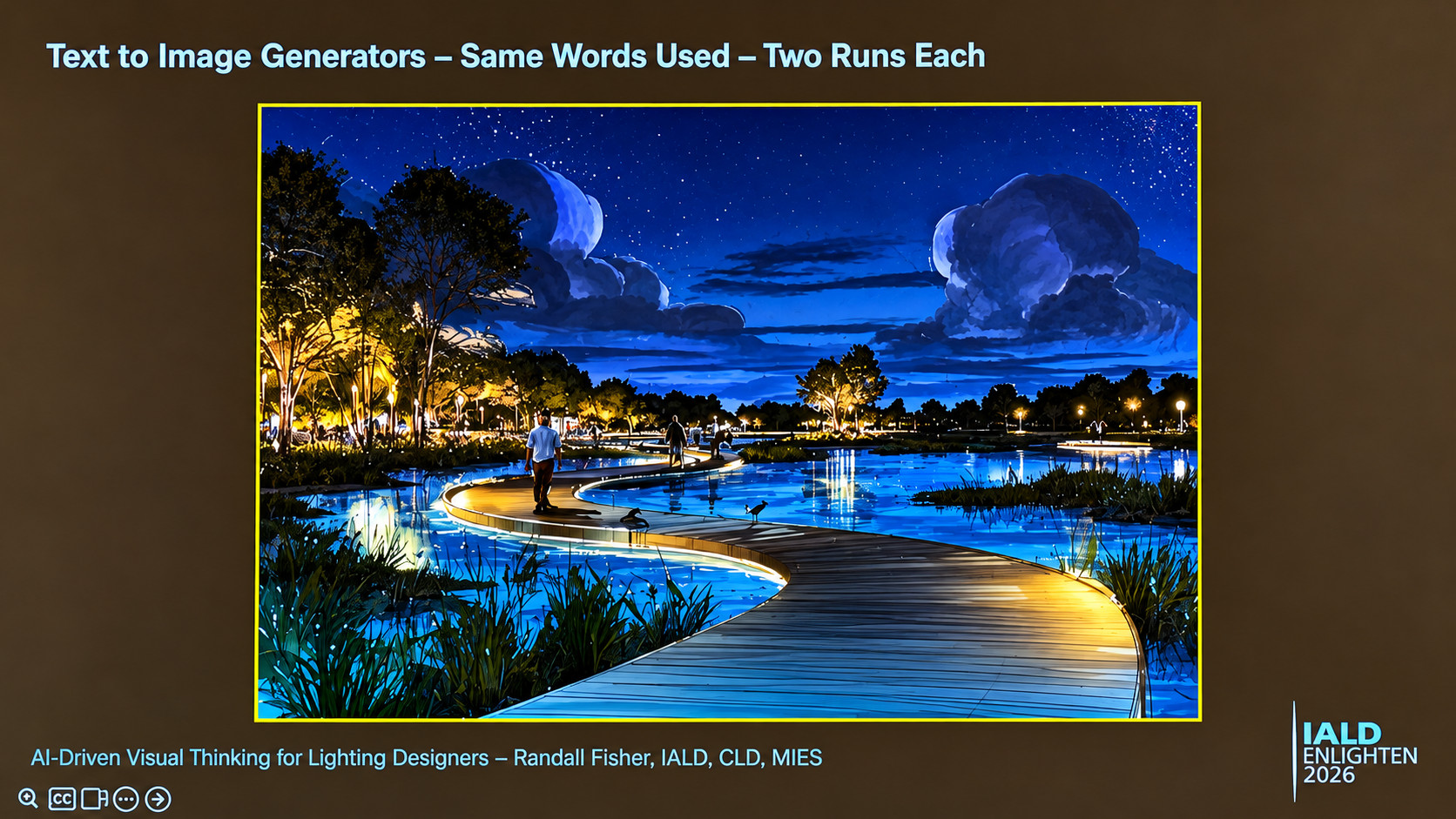
Enlightened Night Boardwalk Landscape
Same Prompt, Different Results
Randall began experimenting with AI graphics in October 2023. Since then, he has explored ways to integrate image generation into his visualization process, including Midjourney, Photoshop, and tools such as Nano-Banana.
To demonstrate the differences among image models, he showed what happened when he gave several platforms the same prompt. The brief described a nighttime landscape concept with paths over marshland, sustainable design, active people, and a loose marker-sketch style.
The results varied considerably.
Some images captured the desired drawing style. Others interpreted the request for a competition board more successfully, arranging multiple elements into a presentation. However, references to sustainability sometimes produced excessive lighting or visual features that undermined the intended message.
The exercise showed why choosing an image requires more than identifying the most attractive result. Designers must examine which parts of the brief the tool understood and which parts it ignored.
Randall also warned attendees to read every word of generated text. A convincing presentation board can contain invented statements or errors that become the designer’s problem once they reach a client.
Ask AI What It Sees
One of Randall’s most useful techniques addressed a common source of frustration: the difference between what a designer sees in an image and what an AI tool recognizes.
Before asking a tool to transform a reference image, he suggested asking it to describe that image. Its response can reveal how it interprets the architecture, objects, and visual style.
That information gives the designer a better starting point for writing instructions. It can also explain why a seemingly clear request keeps producing the wrong result.
In one example, Randall used a hotel lobby image to help describe a sketch style he wanted to apply to a landscape. However, a reference to the lobby’s chandelier remained in the prompt. The resulting landscape included a chandelier in a tree. The mistake was memorable, but the lesson was practical. Reusing a prompt requires careful editing. Language that helped one image can introduce unwanted content into the next.
Similarly, an AI tool interpreted a sculpture as a dog. Once Randall examined the reference more closely, he could understand the confusion. The designer’s knowledge of the project had filled in information the image itself did not clearly convey.
Build the Image in Stages
Randall advocated starting simply and adding complexity as needed.
A basic sketch or simplified white model can establish geometry without overwhelming the process with competing visual information. From there, a designer can develop a nighttime setting, introduce lighting effects, and refine the presentation style.
However, even simplified inputs require care. A white model may communicate form effectively while making glazing or transparency harder to recognize.
For more targeted changes, Randall demonstrated Photoshop’s value. Selecting a specific area allows a designer to direct an edit more precisely. Yet repeated operations can create a cumbersome stack of layers.
He also explored workflows that connect prompts, reference images, and image generators through visual nodes. These arrangements allow designers to compare models and develop multiple approaches from common inputs. Organization becomes essential as the number of images and connections grows.
Whatever the interface, Randall discouraged endless reruns of an unsuccessful prompt. After a few attempts, he generally changes the language or reference image. Continuing to generate similar results consumes time and credits without resolving the underlying misunderstanding.
Keep Your Own Visual Style
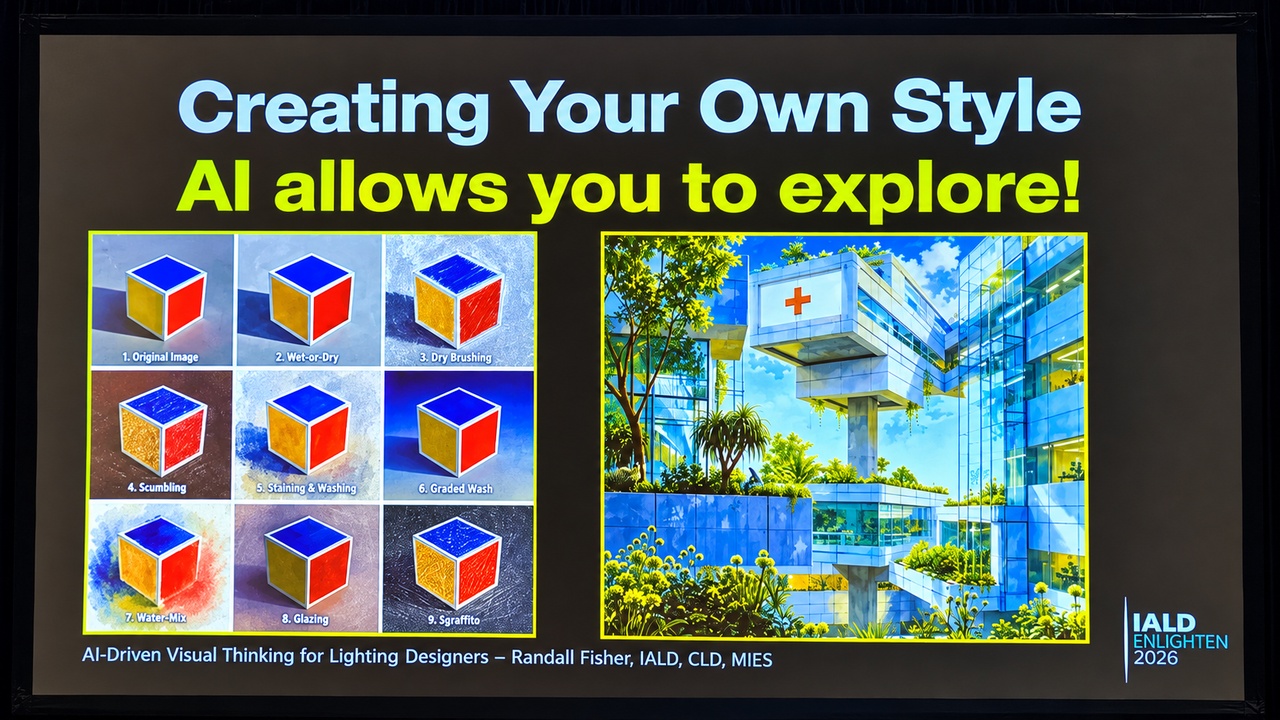
For Randall, efficiency was only part of the opportunity. He repeatedly encouraged attendees to develop imagery that reflected their own visual preferences. He demonstrated variations ranging from loose sketches and wash effects to more finished, realistic images. Those experiments helped him identify techniques he could carry into future projects.
However, he favored beginning with a sketchier approach during early design. A less finished image can communicate atmosphere and intent while leaving room for discussion.
That distinction matters in lighting. A polished rendering may suggest a degree of resolution that the concept has not yet earned. Designers must decide how much visual certainty serves the conversation.
Randall’s examples also showed that adopting a style does not guarantee consistency. An image generator may capture texture and tone while moving lighting effects between iterations. Those changes still require review.
Photoshop Can Come First
Randall initially approached some exercises expecting AI to improve older renderings. The results changed his thinking.
Certain images gained depth or a stronger sense of atmosphere. Others became oversaturated or acquired distracting backgrounds. In one comparison, he preferred the original rendering of a convention center competition entry to the AI-enhanced version.
A hospital project in South Korea offered a different lesson. An older Photoshop rendering already established the intended lighting relationships. AI could use that foundation to develop a more finished image. The experience suggested a flexible workflow: Photoshop can establish the design before AI enters the process, as well as correct an image afterward. A modest investment in a clear starting image may communicate intent more efficiently than a lengthy sequence of prompts.
A Convincing Image Still Needs Scrutiny
The most consequential errors involved the lighting itself. In an interior example, a luminaire intended to create a broad distribution became a narrow line of light. The image looked plausible enough to require close attention, yet it communicated the wrong effect.
That is where lighting expertise remains essential. A tool can produce an appealing scene without accurately representing the specified equipment or intended distribution. Concept imagery therefore requires a designer’s review before it becomes a client expectation.
From Static Images to Interactive Conversations
Near the end of the session, Randall demonstrated experiments with interactive presentations. Using AI-assisted coding, he created files that allowed viewers to adjust apparent brightness and color temperature, switch lighting elements on and off, and move among design options.
He described himself as new to coding and presented the work as an emerging experiment. Nevertheless, the potential was clear: clients could explore alternatives during a meeting rather than interpret a sequence of static images.
Those demonstrations extended the session’s central idea. AI can help designers make lighting concepts easier to discuss, compare, and understand. The responsibility for deciding whether those concepts make sense still rests with the designer.
Randall’s willingness to show the awkward results alongside the successful ones gave that message credibility. The opportunity lies in exploring more possibilities—and applying enough judgment to know which ones deserve to leave the screen.
More IALD Enlighten Americas: HLB Lighting Design Growth: A Candid Debate at IALD
Celestial Park Lighting at IALD. When Light Becomes the Story
IALD Education Trust Reports 71% Drop in Expenses